Showing posts with label Last Things. Show all posts

Sunday, November 13, 2016

On Orientation - 33rd Sunday per annum (OF)

Brethren, we have made it through another presidential election. Our nation prepares for a new president and a new Congress to take office in a few months, whether we agree with them or not. Our first task, as Catholic citizens, is to pray for a good transition and for open minds and hearts among the new administration, so that our Church may flourish and God’s will may be done. We cannot give in to complacency and despair nor should we gloat. There is still a lot of work to be done to proclaim the joyful truth of the Gospel, and the election results must not intrude too greatly upon that work. But there is a second task that we must take up after such a bitter, divisive, emotionally-riddled election; a task which is not necessary merely because of this election, but which is necessary at all times because of our primary calling as Christians, as disciples of Jesus Christ.
Our readings today carry within them a very apocalyptic tone, far more so than any of the most dire predictions being put forward by the media types right now. These readings do not speak of arrests or policy reversals or hatred; they speak of destruction, death, and judgment. They remind us that this world will not endure forever, but that it indeed carries an expiration date. These readings remind us that we need to be oriented towards the true goal of every Christian: not political victory but eternal life. We must be focused upon the end of days.
Orientation carries with it an interesting meaning. Its root word in Latin means the East, which was the easiest direction for ancient people to know due to the rising sun. Whenever we speak of orientation, we usually mean the general direction in which something is travelling or pointing. If we are lost, we speak of reorienting ourselves so as to regain our true direction. Perhaps reorientation is appropriate to how we should be reflecting on these post-election days.
Brothers and sisters, we need to reorient our lives totally and completely to the Lord. We Americans love to play politics and elevate it to a quasi-religion, yet it causes us to lose our true center in God, in Jesus Christ. I do not discourage your political participation, for we are called to live our faith in church and in the public square, but we must keep Christ at the center of our lives, not politics or sports or anything else in this fleeting world. Just as Saint Paul discourages those Thessalonians from being overly concerned with the business of others, so too should we be discouraged from too great a concern on the temporal, the fleeting, the earthly. We must turn to the Lord, the Lord who will be coming very soon.
But how can we regain this spiritual orientation? How can we begin to turn to the Lord? We can begin to do this through returning to a practice that has accommodated the Church in her worship and her prayer from the very beginning. We can begin to reorient ourselves by making Christ the center of our worship. How can this be done? I propose to do this not merely in an interior sense, but in an exterior sense. My proposal is this: beginning on the First Sunday of Advent, we shall celebrate the liturgy here united together and physically turned towards the Lord.
Throughout the history of the Church, Christians have been united together in praying the Mass in a single direction. In fact, the direction usually taken in prayer was to the East, toward the symbol of the rising sun, reminding us of the sun of justice which we heard Malachi foretell in the first reading. The rising sun reminds us of the Lord who has risen from death and will return in the same way as He departed, east of Jerusalem. This idea of unity in posture among the sacred minister and the congregation is not restricted to the Christian religion alone: Muslims will turn to face Mecca while many pious Jews seek during prayer to orient their hearts if not their bodies towards Jerusalem and the east.
I wish us to undertake this united position of worship for a few reasons, the first of which I offer today. We Christians have become increasingly oriented towards the now, something which I believe this election highlights in an extreme way. We too often focus on the here and now, on what we can do here instead of remembering that we are called to be pilgrims on the journey to the eternal Promised Land. We often are like the ancient Israelites wandering through the desert who desire the comforts of Egypt rather than the far more glorious splendors that await the end of the journey. We have lost our true orientation.
But Jesus reminds us of this in our Gospel today when He first foretells the destruction of the physical Temple in Jerusalem, then the great calamities that shall occur at the end of days. The Lord desires to orient us not towards the current reality, which can change in a minute, but towards the eternal realities that shall endure forever. This month is normally dedicated towards a consideration of the last things as they are called: death, judgment, heaven and hell. But we Christians should have these things foremost in our minds: to be prepared for death, to fear being judged against Christ, to hope for heaven and to pray and work to avoid hell.
Our worship should reflect this eternal orientation by having us turn towards the Lord of history, by being watchful for the One who promises that He shall return from the same direction as when He first arrived in this world. Our worship should reinforce the true Christian orientation not towards the petty squabbles of politicians but to the Lord of all time and space, the Lord who shall endure forever, unlike all the nations of the earth. Our worship should have us truly living in the blessed hope of the coming of our Savior, when He shall return to judge the living and the dead and grant to all the faithful eternal life.
I ask for your patience as we begin this change, but I also ask for openness. We should not be afraid of our traditions, even those that we have forgotten, but we should seek the best from the old along with the new. Let us pray that we may be oriented towards Christ more and more each day, not only here in church but in the sum of our lives. Let our hearts become oriented to the true Savior of the nations, the only one who rules the earth with full justice, as we shall celebrate next week. Let us be the pilgrim people of God, journeying not for the fleeting pleasures of this world, but marching eastward, marching towards the Lord, towards the full glory and splendor that awaits the faithful in eternal life.

Sunday, October 2, 2016

The Mass as Foretaste of Heaven (Part 3)

NB: This is the third in a series of sermons on the Mass, preached on the 27th Sunday per annum.

The angel showing St John the heavenly Jerusalem
Manuscript, 11th century
There are many days that we may sound like Habakkuk in our first reading: that we have cried out to the Lord due to the presence of evil, and yet it seems as if God does not hear or does not respond. The world seems to grow darker, and not just because of the change in the seasons. We feel pressed on all sides, from the militant attacks of Islam to the oppression of Western secularism. Where is God in these days? Why does He not answer us? Yet we find in two places the answers that we seek in our times of trial and difficulty.
Our readings encourages us to faith as one of those answers. In response to Habakkuk’s cry of woe, God tells the prophet that what the Lord has revealed shall come to pass, though it may not happen when the prophet desires. The divine plan of salvation works on God’s time, not ours, and we cannot rush it or advance it before the preordained moment. Nothing any of the prophets or ancient ones did before the birth of our Savior caused that birth to happen earlier. In the fullness of time Jesus was born, and not a moment too soon.
It is the same in our own day. We know that this world has an end date, the final hour when all shall be re-created and the divine judgment shall be wrought upon all souls, sending the good to eternal life and the bad to eternal punishment. We would like to see this happen now instead of waiting and enduring the hardships of our age, yet that may not be the divine plan for us. But Jesus offers us the gift of faith. He is not saying in our Gospel today that our faith must increase, as if we do not even possess the mustard seed-sized faith He mentions. What Jesus desires is for us to act in the faith we have received, no matter how large or small it may be. Our faith does not need to be increased, but it needs to be activated. If we believe, even if it is only in the few things we know and understand about God, we can persevere through the darkest of trials. And that leads to the second place where we can find the answer to this time of darkness.
What does it take to endure a long and arduous journey? It is knowing, even in some shadowy way, the destination at the end of the journey. The classic hero’s journey often does not have a definitive destination, but our hero is willing to endure whatever is thrown at him because he knows and believes in what he is fighting for. We Christians know in an intellectual sense what awaits at the end of our journey here on earth: the glorious splendor of Heaven. Yet we can lose sight of this goal amidst the temptations and trials that befall us. How do we keep ourselves single-minded in our earthly pilgrimage? Through our participation at the Mass.
We have been given the Mass as not only the primary act of worship to God, not only as the rest that strengthens our soul, but also as the foretaste of our experience in Heaven. I emphasize the word “foretaste”, for even the most splendid papal liturgies in Saint Peter’s Basilica cannot compare to the glory and majesty that we shall encounter in the halls of Heaven. Yet the Mass provides a glimpse, a pulling-back of the veil between Heaven and earth that allows us to perceive the reward of the saints.
We see this also spelled out by our patron Saint John in that awe-inspiring Book of Revelation. After outlining the final battle between the forces of good and evil, between the Lamb and the dragon, Saint John is given a vision of the new heavens and the new earth that shall endure forever after the terrifying last day of wrath and judgment. He calls it the heavenly Jerusalem, as did the Apostle in the Letter to the Hebrews (Heb 10:22-23). But John specifically points out how there is no temple in this celestial city, for God is worshipped no longer in shadows and images, but is really present among His people, and He will never be taken away.
This is the vision and the glory that is foreshadowed in the Mass. For each time we are gathered at Mass we do this not merely as a physical body, but we are united to that mystical body of the Church which occupies every age and the eternal age. We also do not merely participate in the liturgy which occurs now, but also in that final and eternal liturgy that is the reward of the just. When Jesus becomes really present to us in the Eucharist, we are brought to the wedding feast of the Lamb to His bride, that nuptial banquet that will never cease for those who have persevered in faith.
Let us take up the words of our psalm today, and seek to hear the voice of the Lord echoing to us through the Mass. Let our hearts not be hardened by the sin and sadness of the world, but let us remain faithful to God who is faithful to His word. Let us be aware of the eternal glories hidden in the Mass, of that beatific vision of God in which we will find our rest. Let us do as Saint Paul told Saint Timothy so long ago: “bear your share of hardship for the gospel with the strength that comes from God” (2 Tim 1:8). Let us remain firm in the faith Jesus has given us so that we may join Him at the end of days in the glory that awaits His faithful ones.

Sunday, October 11, 2015

28th Sunday per annum (OF) - Gaining Eternal Life

If there is one thing that we humans fear most, one thing that we truly desire to avoid, it is the reality of death.  We fear that terrible day, that day of wrath in which our souls will be separated from our bodies and we shall be no more on this earth.  We will do anything to either delay that foreshadowed meeting or to even prevent it completely.  Many physicians today offer us pipe dreams of being able to live forever while computer scientists tell us that we will be able to transcend this physical limitation and live on not in the flesh, but in the machine.  But all of these things are bound to fail, and just as the leaves this time each year change their colors and die, so too will each one of us pass and reach “the undiscovered country from whose bourn” only one traveler has returned.
Jesus never promises that we shall avoid death, but He offers to us the opportunity of gaining eternal life.  And so we hear in our Gospel a young man ask our Lord about what must be done to gain eternal life.  The initial response from Jesus is rather surprising: He seemingly rebukes the questioner for calling Him “good” and declares that “no one is good but God alone.”  Some will see this as a denial by Jesus of His divinity, but that is not the case.  It is, rather, a different way of acknowledging His divine nature.  No human being can be called completely good due to the perpetual struggle within our nature between the grace and call of God to holiness and the weight of temptation which tries to drag us down and separate us from God.  Only God is completely and essentially good because He is the source of all goodness.  To call Jesus “good” is to acknowledge that He is God: that He is the Son of the God the Father, “God from God, light from light, true God from true God” as we profess every Sunday.  Since Jesus is God, He can truly be the Good Master who knows completely and from within His being the right path to eternal life.
This right path which Jesus proclaims in answer to the young man’s question seems surprisingly simple: obey the commandments.  That’s it?!? That’s all one has to do?  Yes, it is, but it is not as simple as we may think.  We must plumb the depths of the commandments to understand what God asks of us in them.  Elsewhere in the Gospels, we hear Christ clarify what is meant by the commandments.  Adultery, for example, means more than avoiding the single act of adultery, but each time we engage in a lustful glance or a lustful thought, we are committing adultery.  To kill does not mean merely murder in the body but also through our words and thoughts about others and to others.  The commandments, then, must be heeded not only in letter but in spirit.
If we want to have eternal life, we must live out the commandments completely, not merely at the basic level.  What we do in this world echoes unto eternity.  Every decision we make draws us towards either heaven or hell.  Each choice brings with it the ultimate consequence: either drawing us to the good God who awaits in heaven or pushing against and away from that same God and plummeting towards hell.  Jesus throughout the Gospels never promises a free ticket to us, nor does He assure us that it will be easy.  What He tells us is what it will take to gain heaven or to lose it all in hell.
But the young man has already been doing all this, and desires more.  He senses that what he has been doing is not enough, and he is correct.  Jesus tells the young man to sell everything, give it away, and to follow Him.  What God desires most of us is a contrite and humble heart which loves God totally and completely.  A robot can obey commandments. A dog can obey commandments. It is not enough merely to obey the commandments.  Our hearts must be aligned towards God and not towards anything else.
Many people throughout the history of the Church have taken these words to their deepest meaning and have left everything to follow Christ.  Saint Anthony the Great and Saint Benedict left the world behind and retreated into the wilderness to meditate on the Scriptures and to live a life of prayer and recollection, attracting many men and women to follow them into the monastic vocation.  Saint Francis of Assisi is famous for his radical renunciation of money in favor of Lady Poverty.  While not all of us are called to this most literal of interpretations, all of us are called to live in a spirit of poverty in which we are not possessed by material goods or wealth but truly belong to God.
This is only possible through the grace of God, as Jesus affirms to the disciples.  Without God’s help, we will not overcome the weight of wealth which burdens our hearts.  With God’s help, we are able to be transformed from a people weighed down by wealth or power or fame or whatever it is which we treasure in our hearts to a people who rise to meet God face to face, loving Him who first loved us.  How great, indeed, shall be the reward for those who are free for love, free for holiness, free for eternal life!
Let us pray to God that our hearts may be purged of all that holds us down.  Saint John of the Cross wrote that
The soul that is attached to anything however much good there may be in it will not arrive at the liberty of divine union. For whether it be a strong wire rope or a slender and delicate thread that holds the bird, it matters not, if it really holds it fast; for until the cord be broken the bird cannot fly. (The Ascent of Mount Carmel 11)
May our hearts be cut by God’s grace from everything which keeps us from flying.  May we seek the aid of Mary through the Rosary in being freed from sinful possession so that we may soar up to heaven.  Let the word of God pierce our hearts so that we may be free.  Let us desire the wisdom which is worth more than silver or gold, the wisdom which demonstrates to us that the only abiding treasure we can ever possess is the infinite and loving God who offers us eternal life.

Saturday, November 22, 2014

Last Sunday after Pentecost (EF) - Excita!

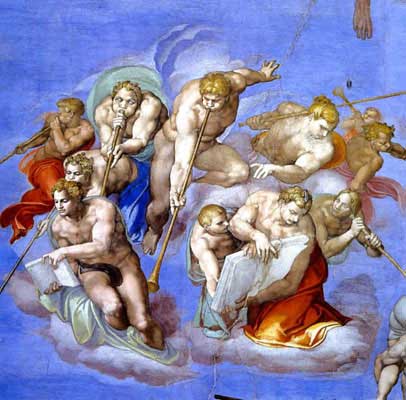
Detail from Michelangelo's Last Judgment in the Sistine Chapel
There are many correlations between this Sunday’s Mass, the last one of the time after Pentecost and thus signifying the end of the liturgical year, and next Sunday’s Mass, the first of Advent and the beginning of the year.  I highlight only one of these correlations as found within the collects which begin the Masses.  The first word of each prayer in Latin is Excita.  Of course, the English mind immediately thinks of the word excite, and truly one is correct in coming to this conclusion.  Yet what does it mean to excite?
The Lewis and Short Latin Dictionary (an essential reference for those studying the venerable language) offers a few ways to understand this word Excita.  It defines Excita the verb as to raise up, to arouse, awaken, incite, or enliven.  We see, then, that this word signifies the action of stirring up or even waking up one from some state of inactivity.  This begs the question: Why does the Church use this word not only on this day but also for next Sunday’s Mass?

We will look at the use of Excita for next week’s Mass next week (a little incentive to keep you coming!) but for this week, we can link Excita to the image Our Lord presents in the Gospel of the angel’s trumpet.  In the midst of describing in a mysterious manner the last days of the universe, Christ tells us that the Son of Man “shall send his angels with a trumpet and a great voice” after He has returned (Mt 24:31).  It is this passage that is central to interpreting the Church’s use of this word in our prayer and what effect it should have upon us.
This month of November is normally dedicated to the consideration of the Last Things since the Sunday Masses place us this impending mystery before us.  While this theme is certainly appropriate for the end of the liturgical year, it is also the fundamental inspiration for why the Church operates in this world.  Eagerly awaiting the coming of her Savior, of her beloved Bridegroom, the Church strives to call souls to that same hope and same love before the angel’s trumpet is heard, before that same Bridegroom comes to carry out His most terrifying task as the Judge of the living and the dead.
But this task of calling does not end once souls have entered into the bosom of Holy Mother Church.  Far from it!  For now comes the task of leading souls away from sin, from Satan and all his works and pomps, so that these souls may begin to live and breath that same faith, hope, and love with which Christ infused the Church.  We must always remember that our entrance into the Church, our incorporation into the Mystical Body of Christ, does not come with a guarantee or a punched ticket; it comes only with a promise: “Abide in me, and I will abide in you” (Jn 15:5).
How often it happens in our lives that we are thrilled with entering into some new activity or receiving some new toy or gadget, yet that thrill vanish after a short time and the activity becomes routine or boring, the toy becomes old and no longer carries the same curiosity.  This is most especially true in our ecclesiastical life, and even more so for those of us who have discovered or returned to the Church: we are excited and filled with awe at her teachings and her rites, her Gospel and her history, and we seem to want more, more, more!  Yet we sink into a pattern of familiarity, of routineness, a pattern that seems to make all of this just seem like anything else.  Our minds become dull with the loss of that newness, our hearts grow weary because what we expected has not come to be, our souls seem to become fixed in their ways or (even worse) to start retreating from the progress we had made back to the old comfortable sins, the easy way of living.  Like the natural world all around us, we seem to shrivel up and grow dry and cold.
It is to this that the Church, as a most loving and caring mother, knowing what is best for us, concludes the year.  She cries out to us: “Wake up! Rise up! Awake from your slumber!” She shocks us like a foghorn to the ear, like a bolt of lightning surging through our bodies.  The Church, in her perennial wisdom, knows that we human creatures too easily slack off and grow weary of the fight, grow tired of waiting, and so she revives us by her prayer.  “Stir up your people, we beseech you, O Lord!” she cries in our Collect.  Stir up your people, that they may rise from their sleep and remain true to your word.
Let us, then, be roused from our complicity.  Let us be awakened from the slumber of sin and the ease of error.  Let us arise and be “strengthened with all might according to the power of [God’s] glory, in all patience and longsuffering with joy” as St. Paul encourages us in our Epistle this day (Col 1:11).  If we have failed in sin, let us beseech God’s mercy.  If we have grown slack in our spiritual lives, let us pray Him that His grace may envelop us and His Holy Spirit stir us up to activity.  If we feel weak and unprepared, let us pray along with St. Paul that we “may be filled with the knowledge of his will, in all wisdom and spiritual understanding” so that we may “fruitful in every good work and increasing in the knowledge of God” (Col 1:9-10).
Let us not join the nations who will mourn and bewail the coming of the Just Judge when His sign appears and His angels blast their might trumpets, but let us lead lives worthy of preparing to face the Judge confident in His mercy and His grace as leading us into glory.  Let us not fear the trials and tribulations which will come, either the daily struggle which forms us into saints or the heroic struggle which signals that the last and terrible day is at hand.  Let us endure all these things so that, being excited by Holy Mother Church, we may be made worthy to be partakers of the saints in the eternal light (cf. Col 1:12).