Showing posts with label Extraordinary Form. Show all posts

Thursday, May 5, 2016

Ascension of the Lord (OF/EF)

Each year, Holy Mother Church commands her pastors to bless a large candle at the Easter Vigil. This candle is then processed through the Church and placed in the sanctuary, where it burns at each Mass of Eastertide until today.  This Paschal candle is meant to be the symbol of the resurrected Christ, who is the Light of the World banishing the darkness of sin. This candle reminds us that He who once was dead lives once more and does not rest in the tomb, but remains close to His apostles, showing them His sacred wounds and further instructing them on the mission that He has given to them. But on this, the feast of the Ascension of our Lord into Heaven, Holy Church commands us to extinguish this candle so as to better awaken us to the reality of this feast: the reality that our Lord no longer physically remains on this earth, but has ascended to the right hand of the Father, as we profess in the Creed.
Yet we should not greet this moment with sorrow over our Lord’s Ascension, as if He is leaving us behind or abandoning us. For, on the contrary, the Psalmist tells us that “God ascends in jubilation, and the Lord ascends with the sound of the trumpet” (Ps 46:6). We are called to rejoice on this day, not to be sorrowful. We are to rejoice, for our God and King mounts His throne prepared for Him, to reign over His Kingdom. We are to rejoice, for our High Priest ascends to the altar of Heaven, where He who is ever-living makes a continual intercession for us before God (Hebrews 7:24-25). We are to rejoice, for the Lamb who was slain goes to prepare the wedding feast in which the faithful will be united with Himself at the end of days (Rev. 19:7-9).
We should not be sorrowful that He has left, because this world is not ready for Him to rule. Our Lord now possesses that glorified and incorruptible body which is promised to all on the last day, but this day has not yet come. Our world is still filled with corruption and sin, still remaining dark in many corners of the world, still blind to the true Light which burns without being extinguished. How can He remain here in that state of finality when the world remains incomplete? Our Lord ascends to Heaven so as to remind us that we are not meant for the world as it stands now, but for the glories that await in the world to come.
But whom are these glories meant for, if not for all of humanity? And how will all hear of these glories, if no one preaches them, if noone is sent out to preach? (Rom 10:14-15) This is why the last command given by Christ to His apostles is to “go out into all the world and preach the Gospel to every creature”, waiting for the Holy Ghost to come so as to be His witnesses to the utmost parts of the earth (Mark 16:15; Acts 1:8). This is the mission of the Church, that mission which we will pray for over the next nine days and commemorate on the 10th.
Let us then rejoice at this Mass today, that the Lord has risen on high and taken captivity captive (Ps 67:18). Let us pray to our Lord this day that He may be nearer to us not in His physical presence, but in His real presence in the Eucharist. Let us also pray for the fresh outpouring of the Holy Spirit this Pentecost, that we may be strengthened and encouraged to proclaim the Gospel message to every creature. But let us also prepare ourselves for that day when He will return, as the angels promised. Let us be watchful and look to the East in eager expectation of our Lord coming as He left us, so as to subject all beneath His feet and to rule in that eternal Kingdom where all shall be gathered to Himself and share in His glory for ages upon ages.

Saturday, May 2, 2015

Fourth Sunday after Easter/May Crowning (EF)

As has been appropriate for Mays immemorial, we have crowned Our Lady on this first Sunday of May so as to open this month in which we hold her most dear to us.  Bl John Henry Newman, in his devotions for the month of May, relates how Our Lady is most fittingly honored during this month.  Newman writes: “May, therefore, is the time in which there are such frequent Alleluias, because Christ has risen from the grave, Christ has ascended on high, and God the Holy Ghost has come down to take His place. Here then we have a reason why May is dedicated to the Blessed Mary. She is the first of creatures, the most acceptable child of God, the dearest and nearest to Him. It is fitting then that this month should be hers, in which we especially glory and rejoice in His great Providence to us, in our redemption and sanctification in God the Father, God the Son, and God the Holy Ghost.”  Indeed, we should glory and rejoice in her through whom salvation has come and in whom the Church remains sanctified and united to her divine Bridegroom.
Our Lady deserves our praise not only because of every good gift, every perfect gift she has received, but because of their source and their purpose.  Their source is the Father of lights, who is the best of all givers.  For indeed, God gives more than grace unto each Christian; He gives that which is most dear to Him: His own Son.  And this relates the source of her gifts to their purpose.  Their purpose is for the salvation of souls; in fact, the salvation of the whole world.  God made her so perfect and pure so that she would be worthy to carry the insitum verbum, the Word grafted unto her flesh, and through her, grafted unto the flesh of all humanity.
Let us rejoice, indeed, that God has chosen His lowly handmaid to be the Mother of His Son.  Let us give her the praise that is due to her, singing the new song foretold by the psalmist in our introit, the song praising the marvels the Lord has done through her and with her.  Let us echo the praises of the Church throughout the centuries in honoring who is most blessed among all women.  Yet our praises cannot be enough for her who is such a good and perfect gift to us.
Just as promises are worthless if they are not reinforced by action, so too our praises are worthless if they do not lead us towards the goal of all the gifts we praise in her and from her.  Our Lady certainly receives our praise and gratitude with joy, but she desires to give more than that to her Son, to her King.  She desires to pass on and present more perfectly our entire being as a good gift to return to Him who has given everything for us.  In union with the Paraclete, the divine Spouse who brought her the gift of her Son, she desires to love us completely and to aid us in the ultimate goal which God has in mind for each of us: our sanctification.
The Virgin Queen loves us most when we love her in every part of our lives.  Let us do our part to make each moment of our existence ordered towards a greater love of our Queen, and, with her and through her, our eternal King.  Let us order our lives as Saint James instructs us: casting away all uncleanness and abundance of malice, being swift to hear the Word implanted in us by her and being slow to speak and slow to anger.  Above all, we must act in charity towards God, towards Our Lady, and towards our neighbor.
Let us imitate the example of the Blessed Virgin in our lives, orienting ourselves towards the Word implanted in us by the Holy Spirit, whose descent Our Lord foretells in our Gospel.  Let us hear the truth about which we should be more convinced every day: the sinfulness of disbelief even within the Church and within our hearts when we fail to live up to His commands; the justice of Christ reigning from His heavenly throne, to which He will ascend so very soon; and the judgment of God which is already cast upon this generation.  Let us not be afraid to beseech God through Our Lady for every good gift, every perfect gift necessary for us to grow in sanctity through the Word implanted within us at baptism and upon whom we are regrafted each time we worthily receive the Holy Eucharist.  Let us strive to praise Our Lady not only in our hymns and in our prayers, but also in our words and our actions, so that we may merit at the end of our days to enter into the unchangeable and unalterable joy of the Father of lights.

Wednesday, March 25, 2015

The Annunciation

The Annunciation and the Crucifixion (from the Walters Art Museum, Baltimore)
We seem to be suffering from many interruptions to our Lenten devotion over the few days.  Last week, we celebrated the feast of Saint Joseph, that righteous man whom God chose to be the custodian of the Holy Family.  We rejoiced in the humble place that God made in His eternal plan of salvation for the humble carpenter of Nazareth.  But today, on this the feast of the Annunciation, we celebrate the feast which gives rise to our Lenten penances and points us towards the resolution of this sorrowful season.  For in the message given by the angel Gabriel to the Blessed Virgin, we are shown not only the pivotal role of the Virgin in the economy of salvation, but we are also shown the entire purpose for the mysteries we are about to celebrate this coming week.
We are first privy to the importance of Our Lady in the divine plan for the redemption of humanity.  Every dogma and doctrine our Catholic faith professes about her stems from this moment in the Gospels.  She was immaculately conceived in her mother’s womb so as to be prepared for this encounter with the angel.  She had already sworn herself to the state of virginity, and she will in fact remain a virgin all her days, as the angel promises.  She is proclaimed to be the Mother of God so as to affirm the complete divinity of Him whom she was made worthy to bear as her son.  And at the end of her earthly life, having been the dwelling place of the Most High, she will be assumed body and soul into Heaven so as to remain free from mortal corruption.
All of this stems from this short encounter.  How rich is every word we hear from the lips of Our Lady!  However, there is only one word that we desire to hear upon her lips, we poor souls clamoring to God for our redemption and our salvation.  It is the word that was missing from the lips of our first parents in the garden, when they partook of the sinful fruit.  It is the word that God has always desired to hear from His people, yet how often He was rebuked by His chosen flock.  It is a word so simple, yet so potent with meaning.  That word which we desire to hear and do hear proceed from the lips of Our Lady is “FIAT.”
As we hear the angel proclaiming the glories of the One who will be born from the virginal womb, we seem to hold our breaths, waiting for the response of the Virgin.  Saint Bernard of Clairvaux, in his magnificent homily on this text, displays our patience for her answer most brilliantly: “The angel awaits your reply, for it is time that he should return to God, Who sent him. We, too, are waiting, O Lady, for a word of mercy—we, who are groaning under the sentence of condemnation. See, the price of our salvation is offered to you; if you consent, we shall at once be delivered... Hasten, then, O Lady, to give your answer; hasten to speak the word so longed for by all on earth, in limbo, and in heaven... He whom you have pleased by your silence will now be more gratified by your reply.”
And so she indeed replies to the angel and to God with that most humbling word, “Fiat” - “Let it be done.”  By this one word, Our Lady begins to unravel the damage of the Fall.  By this one word, as the hymn Ave Maris Stella tells us, she receives the Ave of Gabriel which transforms the name of Eva.  By this one word, the Virgin gives assent to God, thus undoing the knot of Eve’s disobedience through her obedience.  Just as the human race fell through a woman first, so now does the human race rise again through a woman first.  The parallels between the fall in the garden and the Annunciation fill the works of the Church from the earliest centuries.  St. Irenaeus of Lyons, from the second century, draws out this comparison between the disobedient virgin and the obedient Virgin, reflecting that “[the effects] also of that deception being done away with, by which that virgin Eve ... was unhappily misled,—was happily announced, through means of the truth [spoken] by the angel to the Virgin Mary” (Adversus Haereses, V.19).
O wondrous assent! O glorious obedience! See for yourself, brethren, how we are to respond to the promptings of God.  See how we are to truly live out our lives, not only in Lent, but every day of our mortal existence.  We must desire the will of God in our lives, lest we fail to produce the fruit which God desires to bring forth through us.  But we must also contemplate the meaning of this will, of what it is that God desires for each one of us.  This contemplation must draw us towards the second meaning of the feast, to be found in the proclamation of the angel to Our Lady.
Why is all this happening?  Why is God subjecting Himself to the lowliest of His creatures, as she refers to herself, through His conception in her virginal womb?  This is what makes the Annunciation a wonderful starting point for our preparation and celebration of the Sacred Triduum approaching so soon.  The words of Saint Gabriel reveal to us the mission of the one whose very name, whose most holy name, begins this revelation of the divine mission.
The angel first reveals the name that shall be given to the child, the name of Jesus.  In this name is signified His purpose for coming, for the holy name comes from the Hebrew words for “the Lord saves.”  The very name of Christ indicates His mission while on earth, but the words of the angel do not cease at this point.  The angel says that this child will be great, and will be called the Son of the Most High.  Who is great as is God?  The message reveals the character of this child as being God from God, light from light, true God from true God, as we profess every time we recite the Nicene Creed.  Only one can truly claim the title of the Son of God by being truly begotten, not made, by the Father.  And it is this child who will possess this title in its fullness.
The angel concludes his proclamation with the declaration that this child will receive the kingship of David, a kingship which shall not end over the house of Jacob.  Understand that the angel speaks here of the eternal house of Jacob, now assumed into the holy Church of God, which will continue without end in this world, and in the world to come.  Yet, how will this child receive the kingship which is due to Him?  How does any king receive His kingdom except to do battle so as to secure it from those pretending to have a right to it?  It must be the same with Christ, since His kingdom has been stolen and claimed by the devil.  Remember the temptation in the desert: Satan claimed to have possession of all the kingdoms of the world and that it was in his power to give them to Christ if only for a single act of worship.
And so, Christ will indeed do battle for His kingship, but in His own great way.  He will wage war with the weapons of obedience and fidelity to His heavenly Father, by teaching and doing those things necessary for our salvation.  That battle would conclude on Good Friday, upon the cross of death, which becomes through the precious blood of Christ the new tree of life.  We cannot fully appreciate the weight of the Passion without understanding everything that has led Christ and led us to this moment, nor can we truly rejoice in our feast today without appreciating the consequences of all that the angel declared unto the Virgin.
Let us, then, rejoice in the message the angel has brought not just to Our Lady, but to us as well.  Let us rejoice in Emmanuel truly dwelling with His people.  Let us desire to conform our lives more to the example of our Lord and our Lady.  First, let us imitate our Lord by subjecting ourselves to the motherly care of our Lady, whom God Himself was pleased to make His earthly mother.  No one can love the Son without loving His mother.  Yet, at the same time, no loves the mother best than when they love her Son.  Let us also imitate our Lady by loving the Word of God and desiring to yield to the will of God for our lives, come what may.  Only in this way can we truly live the Christian vocation to holiness, whatever our individual vocations may be.  Let us strive to hold their examples before us this Lent and all the Lents of our lifetimes, so that we may be prepared at last for the eternal Easter celebration, where Christ reigns triumphantly with His Queen Mother in that kingdom which shall not end.

Sunday, November 30, 2014

First Sunday of Advent (EF) - Excita! (Part II)

  Last week, we looked at the common portion of the collects for the Sundays which form the bookends of the liturgical year. We looked especially at the Church's use of the word "Excita!" To stir us anew to conversion and progress in the spiritual life, in preparation for the end of days.  This Sunday, the first of Advent and the inauguration of the new liturgical year, utilizes the same word in its collect. What inspires the Church to repeat this word so soon, and also to use it at the beginning of the year?
  A further examination of the collect will help us to understand this week's usage. The collect begins: "Stir up your power, O Lord, and come." While last week was addressed more to our needs and our conversion, this week sees the collect addressed to God Almighty and beseeching Him to come. In praying this, the Church opens up to us the mystery of Advent and its importance for us. For the heart of Advent is concerned with the coming of God into the lives and history of humanity.
  Certainly, we are praying for God to come and save us, to free us from our sins. In this, we are joining the ancient Jews in their prayer for deliverance, in their prayer for redemption. How long did they suffer in Egypt under the cruel slavery of Pharoah! How long were they thrown about under the various emperors and princes of the eras, becoming a plaything in those exalted men's hands! How long were they even exiled from that which had been sworn over to them, the Promised Land! They sought for the day when God would deliver them from all their enemies and reign over them forever in the kingdom of gladness and joy. Yet how little did they expect God to become personally present to them, to truly come to them as a neighbor comes to a neighbor.
  We, indeed, are the result of those prayers, of those expectations, though these prayers and expectations have not yet been realized completely. Christ our Savior has already come in history, has come to redeem His people, the people He has chosen to be His own. Truly has the Psalm been fulfilled which says, "All who expect you, O Lord, shall not be confounded" (Ps 24.3; see the Gradual).  All those who have waited and are waiting for the Lord to come do not wait in vain, for the Bridegroom is coming, whose birth we will celebrate so soon.
  Yet we are not merely commemorating the expectation of the nations to arrive. We are also a people in waiting. We, however, are awaiting not the fulfillment of the prophecies, but for the fulfillment of God's design. This is what is hinted at in our Gospel for this Sunday. The birth of Christ into the world was only the beginning of the final fulfillment, and Our Lord gives us warning of His final coming, just as we heard last week. When Christ comes this final time, He will not appear in humility and poverty, but in power and majesty, enthroned in glory as the Just Judge come to reckon to each his own. How dreadful shall that day be for those who have not followed the Lamb, but their own foolish designs.
  This is the second way that the Church calls upon God to stir Himself up as if from slumber. For the Church, the Bride of the Heavenly Bridegroom, desires to unite herself to the One she loves, to at last enter into the wedding feast prepared for all eternity. Truly, we should live in fear of that day if we are not progressing in sanctity and repentance, yet for the Christian, the end should be awaited in eager hope. We are not meant to live forever in this sin-filled world, but we are meant to be with God, in the intimate union for which we have been created.
  But this talk of intimate union draws out a third and final way by which the Church calls upon her Lord through this collect. Yes, God has come within the pages of history. Yes, God will come at the last day, on the last page, to close the book of life. But there is a hidden way by which Christ comes to His Church, a way that is only illuminated to us by the saints. This is the way of Christ dwelling within the soul, of the soul becoming Christ-like, as St. Paul tells us has happened to him.
  Christ is present to us insofar as we conform ourselves to His example and His teaching, insofar as we emulate His earthly life. This is the secret of the saints: all of them, though each in their own way, strove not only to imitate Christ, but to become Christ. Read any life of any saint, and you will see them growing further apart from sin and the world and the flesh, and you will also see they draw nearer to Christ: through prayer, through penance, through growth in virtue, and especially through growth in charity. We can have Christ in our lives here and now, the more we turn away from all that is hateful to Him and desire more and more to fill our lives with the good gifts and graces He gives us.

  Let us, indeed, beseech God to come to us. Let us pray that He will fulfill His promise to become a son for us, a child among us. Let us pray that He will come at last as the glorious and triumphant King at the end of days. But let us pray more fervently that He will come into our hearts, into our churches, to dwell among us as the only object of our love, as the only means whereby we live and move and have our being. Take heed to the words of St. Paul in our epistle today, that we will "put ye on the Lord Jesus Christ: and make not provision for the flesh." Let us pray that God will be stirred up so that we may be stirred more completely to know Him, to love Him, and to serve Him, so that we may more completely rejoice at those words: "The Bridegroom comes; go out to meet Him."

Saturday, November 22, 2014

Last Sunday after Pentecost (EF) - Excita!

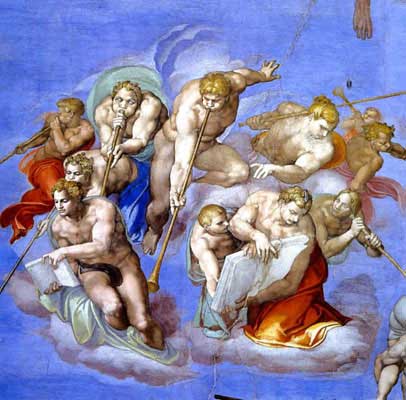
Detail from Michelangelo's Last Judgment in the Sistine Chapel
There are many correlations between this Sunday’s Mass, the last one of the time after Pentecost and thus signifying the end of the liturgical year, and next Sunday’s Mass, the first of Advent and the beginning of the year.  I highlight only one of these correlations as found within the collects which begin the Masses.  The first word of each prayer in Latin is Excita.  Of course, the English mind immediately thinks of the word excite, and truly one is correct in coming to this conclusion.  Yet what does it mean to excite?
The Lewis and Short Latin Dictionary (an essential reference for those studying the venerable language) offers a few ways to understand this word Excita.  It defines Excita the verb as to raise up, to arouse, awaken, incite, or enliven.  We see, then, that this word signifies the action of stirring up or even waking up one from some state of inactivity.  This begs the question: Why does the Church use this word not only on this day but also for next Sunday’s Mass?

We will look at the use of Excita for next week’s Mass next week (a little incentive to keep you coming!) but for this week, we can link Excita to the image Our Lord presents in the Gospel of the angel’s trumpet.  In the midst of describing in a mysterious manner the last days of the universe, Christ tells us that the Son of Man “shall send his angels with a trumpet and a great voice” after He has returned (Mt 24:31).  It is this passage that is central to interpreting the Church’s use of this word in our prayer and what effect it should have upon us.
This month of November is normally dedicated to the consideration of the Last Things since the Sunday Masses place us this impending mystery before us.  While this theme is certainly appropriate for the end of the liturgical year, it is also the fundamental inspiration for why the Church operates in this world.  Eagerly awaiting the coming of her Savior, of her beloved Bridegroom, the Church strives to call souls to that same hope and same love before the angel’s trumpet is heard, before that same Bridegroom comes to carry out His most terrifying task as the Judge of the living and the dead.
But this task of calling does not end once souls have entered into the bosom of Holy Mother Church.  Far from it!  For now comes the task of leading souls away from sin, from Satan and all his works and pomps, so that these souls may begin to live and breath that same faith, hope, and love with which Christ infused the Church.  We must always remember that our entrance into the Church, our incorporation into the Mystical Body of Christ, does not come with a guarantee or a punched ticket; it comes only with a promise: “Abide in me, and I will abide in you” (Jn 15:5).
How often it happens in our lives that we are thrilled with entering into some new activity or receiving some new toy or gadget, yet that thrill vanish after a short time and the activity becomes routine or boring, the toy becomes old and no longer carries the same curiosity.  This is most especially true in our ecclesiastical life, and even more so for those of us who have discovered or returned to the Church: we are excited and filled with awe at her teachings and her rites, her Gospel and her history, and we seem to want more, more, more!  Yet we sink into a pattern of familiarity, of routineness, a pattern that seems to make all of this just seem like anything else.  Our minds become dull with the loss of that newness, our hearts grow weary because what we expected has not come to be, our souls seem to become fixed in their ways or (even worse) to start retreating from the progress we had made back to the old comfortable sins, the easy way of living.  Like the natural world all around us, we seem to shrivel up and grow dry and cold.
It is to this that the Church, as a most loving and caring mother, knowing what is best for us, concludes the year.  She cries out to us: “Wake up! Rise up! Awake from your slumber!” She shocks us like a foghorn to the ear, like a bolt of lightning surging through our bodies.  The Church, in her perennial wisdom, knows that we human creatures too easily slack off and grow weary of the fight, grow tired of waiting, and so she revives us by her prayer.  “Stir up your people, we beseech you, O Lord!” she cries in our Collect.  Stir up your people, that they may rise from their sleep and remain true to your word.
Let us, then, be roused from our complicity.  Let us be awakened from the slumber of sin and the ease of error.  Let us arise and be “strengthened with all might according to the power of [God’s] glory, in all patience and longsuffering with joy” as St. Paul encourages us in our Epistle this day (Col 1:11).  If we have failed in sin, let us beseech God’s mercy.  If we have grown slack in our spiritual lives, let us pray Him that His grace may envelop us and His Holy Spirit stir us up to activity.  If we feel weak and unprepared, let us pray along with St. Paul that we “may be filled with the knowledge of his will, in all wisdom and spiritual understanding” so that we may “fruitful in every good work and increasing in the knowledge of God” (Col 1:9-10).
Let us not join the nations who will mourn and bewail the coming of the Just Judge when His sign appears and His angels blast their might trumpets, but let us lead lives worthy of preparing to face the Judge confident in His mercy and His grace as leading us into glory.  Let us not fear the trials and tribulations which will come, either the daily struggle which forms us into saints or the heroic struggle which signals that the last and terrible day is at hand.  Let us endure all these things so that, being excited by Holy Mother Church, we may be made worthy to be partakers of the saints in the eternal light (cf. Col 1:12).

Saturday, October 25, 2014

Christ the King (EF)

Christus vincit, Christus regnat, Christus imperat.  Christ conquers, Christ reigns, Christ commands. This ancient anthem is most appropriate for this feast of Our Lord Jesus Christ the King.  It reveals to us how it is that Christ is our true king and helps us to understand how this applies to we who are His loyal subjects.  For all earthly kings have conquered, reigned, and commanded, but only Christ has done these things in a perfect and salvific way.  Let us see how, then, He has brought about these actions.
Christ the King has conquered all the enemies of humanity: sin, death, Satan, ignorance, and error.  But He does not accomplish this victory with an army; He does not conquer with myriads of angels or men behind Him storming the battlefield.  No, indeed, Christ has won this conquest upon the Cross.  Our entrance antiphon points us to this when it declares: Worthy is the Lamb who was slain, to receive power and divinity and wisdom and strength and honor (Apoc. 5:12).  Christ the sacrificial Victim, Christ become the Passover Lamb, is the same Christ who is King.  Betrayed by His people, scourged for our iniquities, marched towards the dreaded hill, and nailed to the Cross, Christ shows the way of God in conquest is not through power but through humility and obedience.  Saint Paul rejoices in this conquest as he writes to the Colossians: Christ making peace through the blood of His cross (Col. 1:20) so as to bring about the long-sought-after redemption of man from Satan’s tyranny.
Truly, Christ works in opposition to Satan.  Whereas Satan worked through subterfuge and deceit, Christ who is the Truth shines for all to see Him.  Whereas Satan attacks and attacks again and again, Christ the Lamb is wounded again and again so that we might be healed.  And whereas Satan seeks to make himself the highest and the greatest, Christ, who has been King from the very beginning, humbles Himself and becomes a slave.  This is how Christ conquers the dreaded enemies: with humility, with obedience to the Heavenly Father’s will, with love.
Having conquered the enemies, Christ now reigns triumphant from His throne.  But again, His throne is not the normal earthly seat festooned with jewels and trinkets.  The throne of Christ while this sinful world exists is the Cross.  His crown is formed of thorns piercing His sacred Head.  He appears naked before the world: no royal purple enclosing Him except the purple of His precious Blood, no gold shining from before His Heart except the gold of a holy and perfect life, no courtiers to attend to His need except His sorrowing Mother who can do nothing to abate the pain.
The reign of Christ is not one of a lord above his people, but of God suffering with His people.  C.S. Lewis, in the Chronicles of Narnia, has the King of Archenland describe how a king must reign.
For this is what it means to be a king: to be first in every desperate attack and last in every desperate retreat, and when there’s hunger in the land (as must be now and then in bad years) to wear finer clothes and laugh louder over a scantier meal than any man in your land. (The Horse and His Boy, Chapter 15 “Rabadash the Ridiculous”)
Indeed, Christ reigns far more humbly than even Lewis himself imagined.  He certainly reigns in the glorious moments of life, the celebratory, the wonderful.  Yet He also reigns in the most sorrowful, most desperate, most miserable moments.  He reigns over the wealthy and the poor, the strong and the weak, the wicked and the good.  He reigns over all that has happened, all that is happening, and all that will happen.
Christ reigns over all because He has conquered all.  Everything belongs to Him, and nothing can be brought forward which we could truly declare to be free from the reign of Christ.  How can this be so, when Christ declares that My kingdom is not of this world?  This is because God, in all things, cooperates with man and does not rule by tyranny.  Just as He has left the Church as the instrument of salvation in the world and placed authority within men to rule and guide her, so too does Christ give power to man to govern and order his world so as to conform it to God, who is Himself ordered unto perfection.  God, St. Paul tells us, hath delivered us from the power of darkness and hath translated us into the kingdom of the Son of his love (Col 1:13).  This divine kingdom, this divine reign of Christ, is not in competition to the worldly powers, as perhaps Pontius Pilate thought, but is meant to be the true image of how man is to reign, in preparation for the consummation of the world.
Having conquered as a king, now currently reigning over us as king, Christ then commands us as our King.  The Latin word imperium signifies the ability to wield authority or having the ability to command another.  Is there anyone who has earned this right to authority over Christ?  Certainly not, after his triumphant conquest upon the throne of the Cross.  Christ has demonstrated to us through His Passion and Crucifixion that the heavenly Father has given Him the imperium over the entire world and over the totality of humanity.  When Christ speaks, He speaks on behalf of the Father.  When Christ commands, He commands on behalf of the Father.
But the imperium of Christ should not be seen as a subjection or a slavery to God.  Rather, it should be seen as an elevation, an entrance into the true freedom desired by the Trinity.  Christ does not command like some earthly emperor, but commands as a father commands a son, as a brother commands another brother.  He encourages and beckons mankind upwards towards divine intimacy, towards divine union.  Every word that He gives in the Gospels is meant to point us towards the reason why Christ came: to bring about the redemption of humanity and to unite us with God.  Pope Benedict XVI offered a good reflection on this idea when he said in his pre-papal days: “The Feast of Christ the King is not, therefore, the feast of those who are under a yoke but of those who are grateful to find themselves in the hands of him who writes straight on crooked lines.” (Co-Workers of the Truth, November 30)
Yet, how few there are who listen!  How fewer are they who hear and obey!  How many instead, join the mockings of the chief priests and Pharisees when they exclaim: Let Christ the king of Israel come down now from the cross, that we may see and believe (Mk 15:32).  This modern mockery of the concurrent reign of Christ is what prompted Pope Pius XI to establish this feast in 1925.  As the kingdoms fell and modern man believed himself to be the best judge of his own needs, Pius instituted this feast in the hope that “When once men recognize, both in private and in public life, that Christ is King, society will at last receive the great blessings of real liberty, well-ordered discipline, peace and harmony” (Quas primas, 1925).
This well-founded hope is still true today.  Our nation lies under the crippling effects of moral decay and political infighting, with little hope in either of our political parties or even in the electorate.  The western world is paralyzed by moral incompetency, formal atheism, and little resolve to fight the dangers that stand both on the edges (through militant Islam) and within the borders.  The Church, too, is not immune to this danger, as the past half-century has shown.  Priests and bishops and even cardinals have abandoned the kingdom of God and sought after the praise of men.  Yet Christ still commands, Christ still wields the imperium over the Church now just as He has done throughout the centuries and will continue to do so up to and including the last day.
How then are we to honor Christ as the King of all?  The Church, in her clemency, grants an plenary indulgence today to those who publicly recite the Act of Consecration of the Human Race to the Sacred Heart of Jesus.  Even if we cannot recite this publicly, we can make this act privately, beginning the rejuvenation of the world through our participation in the reign of Christ.  We can renew our efforts to follow the commands and the example of Christ the King, reminding ourselves when we gaze upon the Cross that God is in control: not ourselves, not our political leaders, not even our bishops and pope, but Christ the King is at the heart of all operations, and the more we cooperate with His will for us, the more shall we be rewarded in His kingdom.
We must also proclaim Christ’s kingship to the world, even perhaps back to the Church in which so many have forgotten His reign.  Our lives must echo those of the saints who gave themselves to Christ, not only the martyrs but all the saints.  It is wonderful that this feast of Christ the King occurs before the month of November, which begins with the feast of All Saints and ends with the coming of Advent.  November is a time for reflection upon the last things, and this feast helps place those reflections in context.  If we do not have Christ as our King, then what shall happen to us on the last day?
Finally, we must remember another crown which God has awarded.  There can be no king without a queen.  So too does this happen in the heavenly court: Christ the King reigns with the Queen of heaven and earth beside Him.  Let us turn to the Virgin Mary our Queen, that she may reveal to us how to venerate and serve her King.  As we conclude the month of the Rosary, let us offer those beads to her so that she may form of them a magnificent crown with which to crown the King by our works and our prayers.  Pray to her that we may become more loyal subjects of the King in this life, so as to merit the reward of the King in eternal life.  May Christ conquer, may Christ reign, may Christ command upon us all that we need to venerate Him as King and to share in His Kingship in the glory of heaven.

Saturday, September 27, 2014

Intentional Discipleship II - Sep 27-28

This is the second of two homilies preached at St. Francis de Sales Parish in Benedict, MD, at the request of the pastor on the topic of intentional discipleship.  To see the first homily, click here.

Last week, we looked at the basis for intentional discipleship.  We discovered that it is founded upon a person, upon the greatest Person to ever live on this good earth.  We saw that our reason for being in this building is founded upon the person of Jesus Christ, the Son of God become man.  In this we realized that our religion is not founded merely upon His actions and words, but also in our reaction to those same actions and words, to how our lives are impacted by them.  Now that we see what is the reason for being disciples, and furthermore for becoming intentional disciples, let us find out what it takes to do so.
It is Saint Paul who offers us a wonderful picture of what it means to be a disciple of Christ in his letter to the Philippians.  In directing the church at Philippi towards holiness, St Paul offers this reflection on what it means to be a member of the Church, to be conformed to Christ.  He gives three ways to live the Christian life, to be intentional disciples.  The first is unity.  We as Christians are called together into the one Body of Christ, into the one flock which is the Holy Catholic Church.  If we are one Body, then there must not be division within that Body, just as we cannot tolerate a division within our own bodies.  A group of cells that grows corrupt and poisons the human body is called a tumor, and is oftentimes fatal for the body and for the tumor.  It is the same within the Body of Christ: when Christians plot against the Lord and His chosen leaders (see Ps 2), they form a tumor within that mystical Body.  This is not the way of Christ, this is not the example of the saints.
Saint Paul encourages the Philippians to “complete my joy by being of the same mind, with the same love, united in heart, thinking one thing.”  Why does ask this to be done so as to complete his joy?  Because it is the joy of every true pastor to see the flock united in one just as God desires it.  The Spirit of God does not sow dissension and disunity, but the seed of unity and cooperation.  The laity and the clergy are called to cooperate for the good of themselves and the good of the other.  The laity are called towards obedience to the Word of God and their pastors, supporting them in their labor in the fruitful fields of humanity, while the clergy are called to preach the full Word and distribute the life-giving sacraments to the laity.  There is no room for either of us, laity or clergy, to foment discord out of our own selfish interests or to promote ourselves.  We are all meant to be united in Christ, thinking upon the one thing necessary: what it takes to receive our eternal salvation.  Let us begin to work to do so.
Continuing in his encouragement, St Paul exhorts the Philippians to “humbly regard others as more important than yourselves, each looking out not for his own interests, but also for those of others.”  This is the mark of true charity: a concern that looks towards the needs of others and not merely to ourselves.  Why must we be always so focused upon our own needs and wants when there are so many who are in need of much worse?  Why do we seem leery of showing that charity towards others in our lives?  Did Christ desire only a few to know Him and all that He taught and worked or did He not bring about wondrous works before the eyes of the public?
Charity must begin at home, they always say.  And in this they are correct, for charity must begin among ourselves.  We are called to support one another, to pray for one another, to reconcile with one another.  This charity operates in accord with that unity which we looked at earlier, but the charity which Christ commands and which St Paul describes cannot end with our fellow parishioners.  We are called to be concerned for our fellow Christians around the world who are our brethren in the faith.  We are called also to love all who are our neighbor as ourselves, desiring the good for them, the ultimate good which is a fruitful relationship with Christ and with God.
In the early centuries of the Church’s life, the pagans marvelled at the way the Christians lived, how much they cared for all around them, not just their fellow Christians.  This was the way by which Christianity was spread throughout the world, by our demonstration of what Christ commanded, by our imitation of Christ’s love witnessed upon the Cross.  If we do not have love, then we cannot share it.  Where is your charity?  Where is your love?  How much have you cared for the Church, for your parish, for your pastor?  How much have you loved God and shown Him that love?  Indeed, until we begin to love God, we cannot begin to love our neighbor to the extent to which we have been called.
Concluding his remarks, St Paul offers up the third means to living as intentional disciples: “Have in you the same attitude that is also in Christ Jesus.”  What attitude is that?  It is humility, as we see from the magnificent description of Christ which follows:

Who, though he was in the form of God,
did not regard equality with God
something to be grasped.
Rather, he emptied himself,
taking the form of a slave,
coming in human likeness;
and found human in appearance,
he humbled himself,
becoming obedient to the point of death,
even death on a cross.

Jesus Christ, being God, being a member of the divine Trinity, did not let that separate Him from His people, from us.  In obedience to the Father, He became like one of us, He who is above everything and far greater than everything.  He humbled Himself by willing to become like us in everything except sin: becoming a babe in the womb, becoming a child dependent on His parents, becoming a man dependent upon His own work to live.  All of this He did even to the point of the cruel death He suffered upon the Cross for the salvation of the world.
That is the example of humility we are to follow.  Not accounting ourselves to be anything great and important, but emptying ourselves of vanity and self-deceit so as to be obedient to our heavenly Father.  Not desiring the higher places and greater honors, but submitting ourselves to the lowest places and being nothing in the eyes of others so that the honor and the glory go to God.  Recognizing that we are indeed nothing next to God, yet knowing that God became one of us so that we might in turn become God-like ourselves; so that, just as Christ was exalted to the right hand of the Father and His name echoes triumphant even in the bowels of Hell, we too may be exalted in the halls of eternal life.
But how will all this come about?  How can we achieve this unity?  How can we grow in charity, towards God and towards others?  How can we become humble and Christ-like?  This is where the rubber meets the road for intentional discipleship.  It must echo in every facet of our lives.  Look into the lives of the saints and see how they lived, and you will see this echoed in every one of them.  They never lived the Christian life in halves or quarters or any other sort of division, separating what they believed from how they lived.  And it must be the same for us.  Our lives must echo with unity, charity, and humility if we are going to receive the reward that God desires for us.
But how?  As with all things in the Christian life, we must be a people of prayer, a people in conversation with God, which is the true heart of prayer.  How can we do anything if God is not there to help us?  How can we succeed without God?  We must pray, and in fact we must pray every day for God’s help and for His grace in order to accomplish what He wills for us.  It is primarily through prayer that we will succeed.  Without drawing nearer to God, most especially in the most central prayer that we have - the Holy Mass, without that we cannot gain our reward.
Yet prayer is useless if it is not tied to action, to works.  Just as Christ was obedient in every moment of His earthly life, striving to accomplish the will of the Father, so must each moment of our life be more united to the same divine will.  We cannot be saints on Sunday alone, piously praying and participating, and doing nothing else the rest of the week.  We cannot do that in any other facet of our lives, so why would it be the same as far as our religious life?  If we only cooked for one day, we would starve.  If we only showered for one day, we would be filthy and smelly.  If we only slept for one day, we would make ourselves crazy.  And it is the same in our relationship with God.
Flowing from our prayer must be an ever-increasing desire to obey what God has laid down for us.  This will certainly be different for each of us, since we each have a unique vocation from God, but there are certainly a few general principles to live by.  First, avoid sin.  How can we do that?  By knowing what is sinful, and working to remove the occasions of sins and temptation from our lives.  Second, do good.  We do this in the same way as avoiding sin, by learning what is good and increasing it in our lives.  Third, trust in God.  Without hope in God’s grace and God’s mercy to help us be intentional disciples, we cannot succeed.  He is there for us, just as Christ is near to all who call upon Him.  When in doubt, pray and ask for help, for guidance, for relief.  Seek and you will find, knock and the door will be opened.
Fourth and finally, trust the Church.  Christ has not left us by ourselves to discern all this, but has given us an authority that we can trust to guide us in these matters.  This is probably the hardest for us, because we would rather trust ourselves rather than another.  But Christ did not trust Himself; He did everything in union with the will of His Father, and we must act in a similar way.  Listen to your pastor, your bishop, the Pope: these are the voices by which God speaks to us still.  Consult your pastor for guidance or need.  Read a catechism and learn what the Church proclaims.  Seek the aid of the Church where you can find it.
This is the heart of intentional discipleship - to become what we were meant to be from the beginning: the children of God, the sons and daughters of the heavenly Father, the brethren of Christ the Lord.  Let us not lose sight of this goal, but let us fly towards it.  Let us begin to be like the reformed son and do our yes even if we have said No before.  Let us live not for this world, but for everlasting life.  Let us not be held back, but instead race ahead so as to win.  Let us reach and grasp for the prize, so that we will not be sorrowful for having lost it.  And let us help one another to do the same and be the same, becoming the disciples we should be, so that we will become the saints that God wants us to be.

Saturday, September 20, 2014

Intentional Discipleship I - Sep. 20-21

This homily was given as the first of two homilies for St. Francis de Sales Church in Benedict, MD.  The pastor has asked me to give these homilies concerning intentional discipleship.

I have been asked to preach and discuss about intentional discipleship while your pastor is away.  That’s not what I am going to do directly.  I want all of you for this weekend to focus on one question, on this one question: Why am I here?  I do not mean the great philosophical question about our existence and all that.  I am asking each of you to consider why you are here, why you are present in this church at this hour.  What leads to your decision to come here to worship?  Could you not be spending that time in a more useful pursuit rather than sitting here listening to me speak?
I’m sure quite a few of you have thought that at some point in your life, questioning why you need to grace the church with your presence.  Perhaps you have seen the results of that inquiry in your family and friends who are not now present here.  Perhaps you’ve come close to doing the same.  Yet something keeps you coming back, something poking at your heart or some small voice perhaps echoing inside telling you that you need to go, you need to be there.  And so you continue to come, you continue to be present, yet you probably feel ...
Is this how we are supposed to be in church?  Is this what this hour or our life is meant to be like?  Or is there meant to be more?  Are we called to be spectators, observing what is happening and not doing much more; or perhaps are we called to something more?  The prophet Isaiah declares “Seek the LORD while he may be found, call him while he is near” (55:6), and in this message we can see our response.  Our lives are meant to be a pursuit after something: even better, our lives are meant to be a pursuit of some-ONE, an important distinction.  We are made for the Lord.
This is why we are meant to be here in this building.  This is why we are called to gather together, to gather as one.  We are meant to be discovering who this Lord is, and what it is that He desires from us.  We have been made for God, as Saint Augustine famously said in his autobiography, and our hearts are restless until we rest in Him.  Admit it: how little does this world satisfy?  And I mean truly, deeply, completely, without any emptiness, satisfy you?  It cannot!  It is incapable of doing so!  Everything that exists around us is not meant to be the be-all and end-all of our lives.  If you were to sit down and consider everything you hold as satisfying and truly consider the meaning of satisfaction, you would see that there is nothing that this world can offer which can satisfy that definition.
Things in general, and specifically money, cannot do it: we are always desirous of more, even when we have enough.  Honor or prestige are fleeting and can change from minute to minute: how respected was Ray Rice before the video emerged, or any major figure, be it sports or politics or entertainment.  And speaking of all those things, none of them can truly satisfy:  every sports game ends, leaving us desiring more action; every political fight either breaks us or makes us addicts, movies and television all have an end, a point when the credits roll and no more is to be seen.  None of these things can satisfy us, none of these things is enough.  Then where are we to quench this thirst, this desire for something in which our hearts can rest?
Our hearts are meant to rest in a person, in the greatest Person to ever live: Jesus Christ of Nazareth, the God-man.  This is the heart of the Christian religion, of the Catholic experience as passed down to us from Christ Himself: to approach this man who is more than He seems; whose wisdom is far beyond anything we have heard; who has power over everything, even death.  Our cry should be the cry of the people as recalled in the Gospel of Luke when they behold Jesus raise a young man from the dead:  “God has visited His people!” (7:16)  Indeed, God has visited His people, and continues to visit them every time the Holy Mass is celebrated.
Our hearts will continue to be restless until we meet Christ, until we encounter Him and engage in the relationship He has desired to have with each one of us from all eternity.  This is the fundamental message of the Church:  “Come and see!” (John 1:39)  Come and see the one who proclaims the Kingdom of God, that reign in which there is no pain, no sorrow, no loss, but there is found peace.  Come and see the one who brings about that kingdom by acting in obedience to His heavenly Father, even unto the death of the Cross (cf. Phil 2:5-8), that death which heals the world of sin.  Come and see the one who is truly King, victorious over sin and death by rising from the dead.  Come and see the King who is still with us, who is still present to us, and who desires to be with you.
But this cannot be done without our action.  Christ beckons to each and every one of us, calling to us, drawing near to us, wishing to fill us with His life-giving Spirit.  Yet we can turn Him away, either through indifference or through distraction.  We can ignore Him and remain as we are now,  but it will come at a cost.  In the parable of the workers found in the Gospel of Matthew, Christ says that the landowner came to gather men to work at various hours of the day, even at the last hour before dusk.  The landowner, upon the completion of the work, gives each worker the same reward.  Yet what about those who did not answer the call of the landowner?  What happened to them?  They were not rewarded, but were left out, without any reward, without any consolation.
This parable strikes at the heart of what I have been trying to tell you.  No matter your age, no matter how little you may know Christ, no matter how little you may relate to Him, it is not too late.  Jesus beckons to you to come to find the work that is the heart of our relationship with Him.  I do not shy away from saying that it will be work: consult the lives of the saints to see how hard it was for each of them to work so as to come to know Jesus better, love Him completely, and serve Him in everything.  God does not want to lose you, but you have only this life in which to find Him.  After this life, we will either enter into the joys of our reward, even the little that we have done, or we will sink into the oblivion of hatred and despair which plague those souls who chose on their own to abandon God, to ignore Christ, to despise the Holy Spirit.  What we do in this life indeed echoes for eternity, and it is completely in our control.
Our religion is not for bystanders or spectators or loungers; our religion, our faith is for soldiers who hear and answer the call, for pilgrims who rise up and wander towards that which should be truly sought, for lovers who discover one in whom their love can find rest.  Do not be settled in your faith, because faith does not beget complicity.  Saint Paul told the Galatians that “whilst we have time, let us work good to all men” (6:10), and he told the Philippians to “conduct yourselves in a way worthy of the gospel of Christ” (1:27).  Let us hear and respond, let us seek for the rest which our hearts have been yearning for, let us find the one who loves us and desires us to love Him before it is too late.  Indeed, let us discover the meaning of our faith, the purpose of our worship, and the goal of our religion: to know Christ Jesus and to know God and to live our lives conformed to what they desire for each of us.  Let us not wait for heaven, but let us reach for heaven, for only by reaching will we be able to grasp.