Showing posts with label Faith. Show all posts

Sunday, October 2, 2022

27th Sunday of Ordinary Time Year C - Belief in Spite of All

It should be asked whether the invention of the Internet was actually a good thing. We could honestly ask that question of most media, as has been a constant complaint for millennia. The Greek philosopher Socrates, living almost 500 years before our Lord, complained that writing would cause people to stop using their memory. Yet the modern media, in particular the Internet and social media, does more than cause us to forget things, but exposes far more of our society to us. While television can be regulated or controlled by various authorities, the Internet is truly equal in that anyone can share anything. And what is shared concerning the state of affairs of our age is quite frightening.

Perhaps you have heard these things, but if you have not, they should give you pause. The consistent promotion of anti-Christian degenerate values such as sodomy, transgenderism, and the exaltation of the state above the family is consistently on display. We don’t even need to look far to see this happen. This past week, the Kentucky Department of Education issued a document on students who suffer from the mental disorder of transgenderism in favor of the student against their families. The department said that it is not always necessary to inform parents and guardians of any name changes or gender identification or sexual orientation. This is not from New York or California. This is in our state. It is here.

What is happening? What we are seeing is the complete dismantling of everything oriented to God: not just church or religion but even family and the identity of the human person as having both a body and a soul. Every aspect of society is being upended and turned towards the degradation of the human person from one created in the image and likeness of God into a unit only fit for whatever the elites or those in power think they should be. They have pushed God out of the public square, they continue to promote the slaughter of the innocent in abortion and contraception, they continue to unravel everything in the quest to tear down all that good Christians and those in pursuit of the true and the good and the beautiful have sought to build up and elevate over the course of human history.

Are we at the end? It is perhaps possible, though none of us knows the hour or the day. One could rightly argue we are seeing an end of an age, a time similar to the calamitous fall of Rome in the fifth century, signaling an immense transition into a period of further uncertainty, struggle, and woe. It is not getting better. They are striving to label you as fascists, as racists, as enemies of the state. They seek to steal your children and groom them into mindless consumers, only able to enjoy the sensual as the highest good. And it seems as if they are winning.

Yet, as Christians, as followers of Jesus Christ, we know that all this has happened before. We see it in the Passion of our Lord as He is mocked, jeered, derided, spat upon, and hated by the crowds. We see it in the indifference of Pontius Pilate, knowing this to be wrong yet desirous of pleasing the people so politics pushes on. We see it in the cruelness of the Jewish elders who scoff at the Messiah manifested before them. We see it above all in the agony of the Cross, where it seems even the Lord Himself suffers a feeling of the absence and alienation of God, crying out, “My God, my God, why have you abandoned Me?”

We know the rest of the story. We know of the triumph of the risen Savior, victorious through His sufferings and death over all the enemies of God. We know that the tomb is empty, that the promise has been fulfilled, that we are not abandoned or lost forever. We know this, yet do we believe?

The disciples ask Jesus to increase their faith in today’s Gospel. The Apostles are very real men in the sense that they seem extremely weak in comparison to the Lord who towers over everyone whenever we read or hear the Gospels. The passage ahead of this says that the disciples struggled to dispel a demon from a possessed person. So it seems natural for them to ask for more faith in order to perform more works. Jesus rebukes them for asking for more faith, as if it is only magic. We do not need more faith for the performance of works, but we need to live the faith which we have received from God towards the works He calls us to do.

Faith is not a feeling, nor is it a mere intellectual apprehension of reality. Faith is our assent to the truth which comes from God. We believe because it is true but also because God has given us the grace to believe. The small mustard seed of faith has already been planted within us, through our baptism. We must let it grow through His grace and through our works. Hence our Savior tells us to label ourselves as unprofitable servants who did what they were called to do. The response to faith is works: the living out of the truth and reality that there is one God, that Jesus is Lord, that the Church is the only means of salvation, that we are called to more than the glitter of the world and the wiles of the devil but that we are called to eternal life.

We may cry out like the prophet Habakkuk in the first reading, wondering where God is in these dark times, where it seems that everything is turned to evil and all seems but lost. Yet God assures the prophet when He declares, “The rash one has no integrity; but the just one, because of his faith, shall live.” Our task is not to give in to the despair and nihilism that washes over all, but to remain steadfast in faith, steadfast in the Lord. We must do the task God has given us and not grow slack or weary. We will be hated, we will be mocked, we will suffer in one form or another, but if we remain the servants of God, we shall live.

Dear brethren, do not lose heart at the chaos of the world. Do not struggle even when it seems that the smoke of Satan seeps into the Church, when clergy willingly abandon the faith to accommodate the age rather than proclaim the Gospel. We are not called to an age of ease but to the labor of salvation. God still speaks to us, and we must not harden our hearts either by joining the world or by despairing over how quiet God seems. As the last king of Narnia said before entering his last battle, “We are all in the paws of the true Aslan.” God is still in control.

St. Paul, writing near the end of his life, writes to his beloved Timothy, “bear your share of hardship for the gospel with the strength that comes from God.” Let us be strengthened for the battles that lie ahead. Let us live out the faith of the mustard seed which God has planted within us, to stand up for God, for truth, for goodness, and for beauty. Let us oppose all who make themselves the enemies of God with the weapons of prayer and charity. Let us turn also to the help of blessed Mary and all the saints, asking their continued support as we fight the good fight. May we continue to have faith in God, in the entire Trinity, in the one Church of Christ, that we may bear our share of hardships so that we may be worthy of the rest and the joy that awaits in eternal life. 

Sunday, August 26, 2018

21st Sunday per annum - After the Report

I have gone through a great wave of emotions over the past few weeks, since the publication of the Pennsylvania grand jury report which outlines not only numerous accounts of abuse by priests over seven decades, but the numerous ways the various bishops covered up or ignored these wicked priests, with some of these bishops rising to the upper ranks of the Church. The first emotion is anger - anger that this continued for so long, anger that none of the bishops seem willing to hold themselves or their brother bishops responsible, anger that even the pope seems unwilling to do anything serious. The second emotion is sadness - sadness at how many were abused and probably lost their faith, sadness at the people who tried to help but couldn’t get anywhere, sadness that this is dragging the Church through the mud once more.
All of this raises the question of whether it is good to stay in such a Church when there seems to be so many wicked men in the Church, so many who are more concerned about their rank or power rather than where they are leading souls. I am not the only priest who has struggled with these staggering and scandalous reports and wondered what to do or where to go from here. Yet I cannot shake the words that Saint Peter so quickly offers up in the Gospel today: “Lord, you have the words of eternal life.”
Brothers and sisters, where else can we go to hear these life-giving words, in particular the words Jesus has been speaking to us the past few weeks - “I am the bread of life”; “unless you eat the flesh of the Son of Man and drink his blood, you do not have life within you.” These are hard words to understand, even harder to live, as are so many things which the Church teaches, such as the difficult teaching on marriage we hear in the second reading. However, all of these words and all of these teachings come from the lips of the most innocent and truthful Man in all of history, He who declared Himself to be the Way, the Truth, and the Life, He who was willing to suffer the death of the Cross because of my sins so that I might receive that bread of life.
I believe these revelations of scandal and wickedness will be something good for the Church, like receiving the news that one has cancer. It is not the scandals themselves that are good, but that we know they are happening so that we can answer how to remove them and restore the Church to her apostolic glory. The one answer that we ought to have is that we do not believe in men; the psalms warn us against that when they say, “Put not your trust in princes, in whom there is no help.” Our faith is not in a human structure or organization but in God, in Jesus Christ who established and maintains His Church in spite of the wickedness of her members, especially her clergy.
The Church continues in her divine mission because of the grace that the Holy Spirit maintains within her. And where can we find that grace? We find it in the sacraments, and above all we find this grace in the Most Holy Eucharist. Not in the Bible, not in the tradition, not in anything else other than the sacraments which Jesus has given us and which have been maintained by the Church for 2000 years. “To whom can we go?” Peter asks our Lord. We cannot find this in any other religion nor in the absence of religion. We cannot find it in sports, in politics, in technology, in nothing else but in that simple bread and wine transformed by the action of the priest - even the most sinful priest - into the body and blood of Christ.
My dear brothers and sisters, do not lose hope in God or in His Church. There will always be sinful men and women in the Church. Remember that Judas walked with Christ, saw His miracles, and yet still betrayed Him to His death. Yet Jesus transforms that most wicked sin into the greatest good done for all of humanity. Jesus can do the same even with such terrible men at the helm in our day. I don’t know how He will do it, but I believe and trust that He will, and that He will do it even through me a sinner. Our faith cannot be in sinners, nor even in the saints who are in the Church, but God alone who acts in and through both of them. Let us taste and see the goodness of the only one who is truly good - the Lord who offers Himself for us in the Eucharist as our nourishment, our strength, and our foretaste of the glory He desires for us if we remain faithful, if we remain with Him and His Church.

Sunday, August 13, 2017

19th Sunday per annum - The Challenge of Faith

Which do we desire: comfort or challenge? Do we desire the old martial attitudes, focused in such activities as exercise, jousting, or boxing, or rather, do we desire the calm, collected tranquility of such easy activities as television, internet, and Netflix? Let’s be honest with ourselves: we want comfort. If we had to pick between remaining in our own time or dropping down into the Middle Ages, we would stay here in a heartbeat, kicking up our recliners to perish the thought of having to toil and labor for the bare minimum to survive. But is this what Jesus wants for us?
If we pay attention to Matthew’s telling of this episode of his Gospel concerning the Lord walking over the waters, we should notice one detail sticking out concerning the disciples: Matthew seems to imply that the boat was tossed about until the fourth watch of the night, or nearly 3 in the morning. Think about that: the Gospel says that as evening approached, the boat began to toss, yet Jesus seemingly abandons them for most of the evening. How terrifying it must have been for the disciples as the boat continued to rock and reel, yet their Master was not there to aid them. But when He does come, they are so frightened by His appearance they believe Him to be a ghost or an apparition.
Yet the Lord offers those prized words of consolation to any soul wearied and troubled: “Be not afraid.” Who responds immediately to this call but Peter, the one most eager to serve Christ? Even though the waves have buffeted the boat all night, Peter remains strong in his faith in Jesus, calling Him to command Peter to walk on those same waters. But even Peter has his weak points: even though he had endured the waves all night, Peter lost faith because of the strength of the wind. He begins to sink and cries out in fear just as the other disciples had done earlier. Only the strong arm of Christ is able to lift him up and put him back on the boat.
What do we see from all of this? First we are taught that our faith must be tested. The strength of our faith is quite similar to the strength of our body. What happens if we are soft on our bodies, feeding ourselves only the sweet and sugary and remaining inert? Our bodies grow fat and weak, susceptible to disease or decay. If we push our bodies, making the grueling effort to regulate our food and to exercise, rejecting the bad and replacing it with the good, we will get them into peak condition and reduce or even eliminate the possibility of disease. It is the same with our faith: we can grow quite soft in what we believe and profess, even to the point of being susceptible to the disease of error or heresy, falling away from the faith for a multitude of petty and irrational reasons. Yet if we push ourselves, learning more who this Jesus is, what He wants from us, what He has in store for us, nourishing ourselves with the sacraments, striving to remove sin and replace it with virtue, we will grow stronger in faith, able to challenge anything that the devil or the flesh or the world throws at us.
Yet we cannot rely on our own strength or ability alone. The disciples were afraid because of the boat tossing about through the night, while Peter became afraid only when he saw how strong the wind was. Each of us has those weak moments that will seem to test or may even break our faith. However, Jesus is always there, holding out to us the strong arm of His grace poured out for us in His sacraments, in particular the sacrament of confession. Our Lord knows our weaknesses, our frailty, our struggle to endure, and He knows that we will at times fail. But He does not want us to sink; rather, He holds out His arm, the arms by which He hung upon the Cross for our salvation, the same arm which He held out to Peter to keep him from sinking. If we are to become stronger in our faith, we must do it with Christ ever near to us, not just there when we want Him.
Finally, we must remember who is the center of our faith, who it is that grants us the ability to believe: God Almighty. Faith is initially a gift of God, a gift that we have not merited and could never deserve on our own. God, in His infinite love for each one of us, gives us every good and perfect gift we need to be holy. But we should never presume upon God’s good will nor should we believe that we have received enough. Jesus teaches us to pray unceasingly for everything we need and more. We ought to be like the prophet Elijah in our first reading: humbling ourselves before the transcendent, invisible God who waits for us to ask for everything. Prayer must be at the heart of our faith, or else we shall fail to grow, no matter how much we may will it or desire it.
Let us not remain comfortable with the minimal faith we have, but let us take up the challenge of living as Jesus commands. Let us cast off from the shores of this world to discover the untamed God who asks so much of us and offers us so much in return. Do not be afraid at the immensity of the task, but look to Jesus, our guide through the stormy seas. Pray that the Holy Spirit may be your Comforter in these difficult days, that His gifts may begin to bear fruit in you, even unto the growth of our church and the sanctification of our community. Let us indeed accept the challenge to follow Jesus Christ each day, that He may lead us through the turbulence of sin and strife to the serene and beautiful coasts of eternal life.

Sunday, October 2, 2016

The Mass as Foretaste of Heaven (Part 3)

NB: This is the third in a series of sermons on the Mass, preached on the 27th Sunday per annum.

The angel showing St John the heavenly Jerusalem
Manuscript, 11th century
There are many days that we may sound like Habakkuk in our first reading: that we have cried out to the Lord due to the presence of evil, and yet it seems as if God does not hear or does not respond. The world seems to grow darker, and not just because of the change in the seasons. We feel pressed on all sides, from the militant attacks of Islam to the oppression of Western secularism. Where is God in these days? Why does He not answer us? Yet we find in two places the answers that we seek in our times of trial and difficulty.
Our readings encourages us to faith as one of those answers. In response to Habakkuk’s cry of woe, God tells the prophet that what the Lord has revealed shall come to pass, though it may not happen when the prophet desires. The divine plan of salvation works on God’s time, not ours, and we cannot rush it or advance it before the preordained moment. Nothing any of the prophets or ancient ones did before the birth of our Savior caused that birth to happen earlier. In the fullness of time Jesus was born, and not a moment too soon.
It is the same in our own day. We know that this world has an end date, the final hour when all shall be re-created and the divine judgment shall be wrought upon all souls, sending the good to eternal life and the bad to eternal punishment. We would like to see this happen now instead of waiting and enduring the hardships of our age, yet that may not be the divine plan for us. But Jesus offers us the gift of faith. He is not saying in our Gospel today that our faith must increase, as if we do not even possess the mustard seed-sized faith He mentions. What Jesus desires is for us to act in the faith we have received, no matter how large or small it may be. Our faith does not need to be increased, but it needs to be activated. If we believe, even if it is only in the few things we know and understand about God, we can persevere through the darkest of trials. And that leads to the second place where we can find the answer to this time of darkness.
What does it take to endure a long and arduous journey? It is knowing, even in some shadowy way, the destination at the end of the journey. The classic hero’s journey often does not have a definitive destination, but our hero is willing to endure whatever is thrown at him because he knows and believes in what he is fighting for. We Christians know in an intellectual sense what awaits at the end of our journey here on earth: the glorious splendor of Heaven. Yet we can lose sight of this goal amidst the temptations and trials that befall us. How do we keep ourselves single-minded in our earthly pilgrimage? Through our participation at the Mass.
We have been given the Mass as not only the primary act of worship to God, not only as the rest that strengthens our soul, but also as the foretaste of our experience in Heaven. I emphasize the word “foretaste”, for even the most splendid papal liturgies in Saint Peter’s Basilica cannot compare to the glory and majesty that we shall encounter in the halls of Heaven. Yet the Mass provides a glimpse, a pulling-back of the veil between Heaven and earth that allows us to perceive the reward of the saints.
We see this also spelled out by our patron Saint John in that awe-inspiring Book of Revelation. After outlining the final battle between the forces of good and evil, between the Lamb and the dragon, Saint John is given a vision of the new heavens and the new earth that shall endure forever after the terrifying last day of wrath and judgment. He calls it the heavenly Jerusalem, as did the Apostle in the Letter to the Hebrews (Heb 10:22-23). But John specifically points out how there is no temple in this celestial city, for God is worshipped no longer in shadows and images, but is really present among His people, and He will never be taken away.
This is the vision and the glory that is foreshadowed in the Mass. For each time we are gathered at Mass we do this not merely as a physical body, but we are united to that mystical body of the Church which occupies every age and the eternal age. We also do not merely participate in the liturgy which occurs now, but also in that final and eternal liturgy that is the reward of the just. When Jesus becomes really present to us in the Eucharist, we are brought to the wedding feast of the Lamb to His bride, that nuptial banquet that will never cease for those who have persevered in faith.
Let us take up the words of our psalm today, and seek to hear the voice of the Lord echoing to us through the Mass. Let our hearts not be hardened by the sin and sadness of the world, but let us remain faithful to God who is faithful to His word. Let us be aware of the eternal glories hidden in the Mass, of that beatific vision of God in which we will find our rest. Let us do as Saint Paul told Saint Timothy so long ago: “bear your share of hardship for the gospel with the strength that comes from God” (2 Tim 1:8). Let us remain firm in the faith Jesus has given us so that we may join Him at the end of days in the glory that awaits His faithful ones.

Wednesday, December 23, 2015

Fourth Sunday of Advent (OF) - Mary and Her Child


We stand on the precipice of Christmas.  The time grows short, the days are getting shorter and busier, everyone is bustling about trying to prepare.  We are all in haste to get the house cleaned, the presents bought and wrapped, the decorations in place, the lights hanging, everything we need for Christmas.  How much attention, though, do we place on the reason for the season? Certainly, we are not forgetful of why it is that we celebrate Christmas: the birth of the Christ Child into the world.  Yet do we take time to consider the significance of this holiday?  It’s easy to do the work of cleaning and decorating, but are we cleaning and decorating our hearts and minds for the feast day we are to celebrate so soon?
If you pay attention to the prayers of our Mass, you might notice that something is missing: the name of the one who is to be born on Christmas Day.  We must always remember that Christ is not necessarily a name but a title, a title indicating the one anointed or chosen by God.  Throughout our prayers, which normally include the Holy Name, we notice an absence which expresses the longing of the Church for He who is to be born so soon.  It is the longing of our ancestors, the longing of our forefathers, the longing of the whole human race.  It is also the longing of a mother to at last hold her unborn child in her arms and to speak their name for the first time to them.
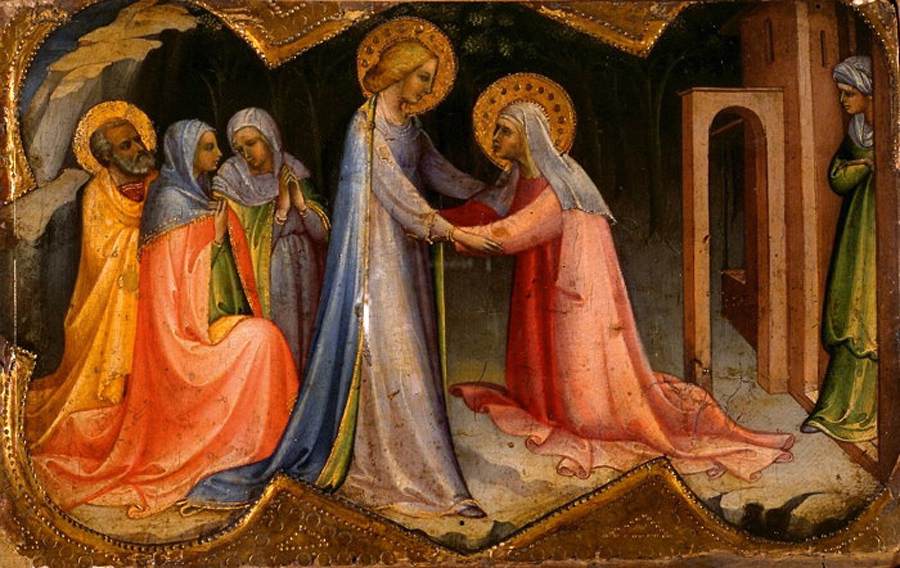
We are journeying now with the Virgin Mary to the town of Bethlehem - foretold by the prophet Micah in our first reading to be the birthplace of the one who is to be the ruler or the king in Israel.  Saint Luke presents to us one part of the journey which Our Lady makes towards her ancestral home in showing us what is traditionally called the Visitation: the period immediately after the announcement by Saint Gabriel to the Virgin Mary that she will be the Mother of God.  The archangel had revealed to her that her cousin Elizabeth had also become pregnant by the power of God; she who had been barren for so long now bore within her womb the one who would prepare the way for the Lord.
Our Lady leaves in haste so as to marvel at what God has done in Elizabeth and in herself.  But no sooner does she greet her cousin than her cousin begins to praise her: “Blessed are you among women and blessed is the fruit of your womb.”  Elizabeth cries out in joy and in humility that she has received the gift of a visit from the mother of her Lord.  Even John rejoices while in his mother’s womb, leaping for joy that the One whom he will proclaim as the Lamb of God has come to him.  Joy overflows this moment which Saint Luke recalls for our consideration.
But even greater joy awaits our Lady: the joy of finally bringing this child into the world.  A mother desires more than anyone else the birth of her child, if for nothing else except to have the child finally out of the womb.  Yet Mary desires this birth for a far greater reason: because of who this child is and what He will do.  She knows that her child is the Savior of the nations.  She knows that her child will be the King who frees His people.  She knows that her child is the one who truly comes to do the will of God in the flesh He receives from her. She knows that her child is the Emmanuel - the God with us.
This is why she eagerly awaits His birth and rejoices with Elizabeth.  Along with her littleness and her humility, God blesses Mary’s immense faithfulness with becoming the most powerful woman in the world, as one magazine recently declared her.  Thus does Elizabeth praise her finally as being blessed because she believed that what was spoken to her by the Lord would be fulfilled.  Believing in God and His desire for our salvation, she who is the handmaid of the Lord has been exalted above every other creature, to the point of even being made the Queen of heaven and earth, all because of her child whose birth is at hand.
Let us rejoice with the Virgin Mary that she is to soon bring into the world the God-man.  Let us praise her, just as Elizabeth praised her, for her faith and her humility while learning from her how to do the same.  Let us be prepared in mind and heart for the coming child through our prayers and our lives.  Let us truly desire to welcome the one whose name will so soon be on our lips, just as it was on the lips of Mary at His birth: the one who is called Savior, the one who is our way and our eternal life, the one who is the God among us: Jesus Christ the Lord.

Saturday, August 8, 2015

19th Sunday per annum (OF) - The Eucharist: The Mystery of Faith

Every time we participate in the Mass in its Ordinary Form, we hear the priest utter this phrase after the consecration of the elements: “The mystery of faith.”  This phrase, originating in the sixth century, has been a constant feature of the liturgy we have used in the western rites of the Church.  When the priest says this phrase at the Mass, we respond with one of three phrases, all of them emphasizing the Eucharist as the memorial of the passion, death, and resurrection of Christ and our eager hope for His continual support.  Yet, in conjunction with our readings today, this phrase helps us to understand more greatly the centrality of faith in our life and how the Eucharist aids us to be faithful and to be faith-filled.
When we hear the word “mystery”, we often think of detectives trying to solve a crime and discover the culprit.  This offers a hint to us of the root meaning of the word, since it comes from the Greek μυστηριον, which means something hidden or secret.  Anything that fell under the term μυστηριον was something which was not meant to be revealed except to those who were in the know.  The Christians took up this term early on in the Church’s history to denote those beliefs and practices which are of a supernatural character, such that we could not understand them on our own.  This is why the term became extended to the mystery of faith, which we find used in St. Paul’s first letter to Timothy.  These mysteries could only be understood as such by those who were Christians.
Our Gospel helps us to understand why this is the case.  Christ, in rebuking the Jews, tells them that “No one can come to me unless the Father who sent me draw him.”  Our Lord reveals to us the beginnings of this belief which enables us to grasp the mysteries of faith.  It is not of our own power or volition, but the gift of God the Father who created us.  God draws us to Himself and to the one Church wherein dwells the wellspring of faith.  It is not by our willing that we have received the faith, but by the will of God.
Yet that faith which we have initially received from the Father can be accepted or rejected by us.  We see this in the soul which decides either to continue to practice the Catholic faith or to reject it and to search elsewhere, to its eternal detriment.  That faith can also be increased or decreased, which leads us back to the Eucharist.  Since, as we have seen before, Holy Communion is the source and the summit of the Christian faith, it is in the Eucharist, the bread of life, that we are able not only to find expression of our faith, but also to be given the grace necessary for our faith to be maintained and even to increase in relation to God.  Just as earthly bread increases our strength so as to live as material beings, so too does the Eucharist increase our spiritual strength to live as spiritual beings.
If we are faithful Catholics, we will desire the Eucharist more fervently each day, because we believe what Christ proclaimed and what the Church has professed and maintained to our present day: that Jesus Christ is still among His people, nourishing them with His body and blood so as to draw them to Himself, most especially on the last day.  St. Pio of Pietrelcina said, “It would be easier for the world to survive without the sun than to do so without the Holy Mass.”  It is in the Eucharist that we find our faith most eloquently expressed, but in a manner that only those with the grace of God are able to receive.  To be a Catholic is to be one who is enveloped in the mystery of faith, most particularly the mystery of faith in the Eucharist, and who lives that faith out not merely in the church, but in every aspect of our lives.
Let us not grow slack, then, in our faith, but be nourished by the bread of life so that our faith may increase.  Let us be nourished as Elijah was nourished in our first reading, so as to go forth and do the will of God in our lives.  Let us taste and see the goodness of the Lord with the eyes of faith.  Let us live in love, as St. Paul urges us to do, being imitators of God, who so loved us as to give His only Son for our salvation, and who continually gives His Son to us to be our bread of life.  Let us appreciate the Eucharist more and more as the mystery of faith; not something to be solved, but some one to be discovered and loved in the embrace of faith, a some one who desires us to live with Him in the reality of eternal life.

Saturday, June 20, 2015

12th Sunday per annum (OF) - Faith


“Do you not yet have faith?”  This question of Christ could be directed not only at the Twelve with Him in the boat, but also to our generation, to modern man.  It seems that modern man, since the so-called Enlightenment, has progressed beyond faith towards reason as the principal method for engaging the world.  Modern man will cry out in relief that he is freed from the oppression of faith and religion and is now capable of moving forwards towards a bright new future, towards achieving the ultimate goal of bringing about paradise on earth.
Yet the century we have so recently closed demonstrates to us the limits of this feigned reason: the exaltation of nations over God, the devastating effects of modern war, the rise of ideologies in place of faith and against reason.  How persistent, though, modern man can be in his mad-dash quest to find something other than faith to cling to, to build upon.  For modern man ultimately fears being a subject, being ruled by someone other than himself, and he fears that faith will make him the meanest, the lowest of subjects in the cosmic order.
Yet the truth is the opposite: faith, instead of lowering us, is what elevates us towards God, towards Him who is the ultimate Good.  Modern man is looking backwards at the whole order when he thinks faith will keep him in the dirt.  It is reason alone and unaided which leaves man squalid in his spiritual poverty.  But by faith, God raises the soul above the merely human and brings it closer to Himself.  By faith, we become the human beings we were meant to be when God first created us in Eden.  By faith, we realize the full potential of our humanity as being the image and likeness of the divinity, and not merely as a rational animal.
Look at the Gospel account for today.  The disciples have been following Christ for some time now.  They have heard His authoritative teachings, they have witnessed His power over those who are sick and in need of healing, they have even perhaps seen some of the great miracles that Christ worked, such as raising people from the dead.  And yet, in spite of all this, they are still petrified of a thunderstorm when Christ is in their very midst.  Thus that indicting question from Our Lord: Do you not yet have faith?
It seems to us from what we have just heard that indeed they really do not have faith in Christ, for they question each other about the calming of the sea by a man, saying, “Who then is this, whom even wind and sea obey?”  Who else can the elements obey but their Creator, the One who gave them form and shape and order and purpose at the very beginning of time.  Who else can they obey but God?!
How much are we like the disciples in that boat on the Sea of Galilee?  We have heard Christ teach to us time and time again, proclaiming the coming of the Kingdom of God and the time of repentance.  We have heard proclaimed again and again the wonders of His earthly life, such as today’s account.  Yet, do we really believe that this Jesus of Nazareth is truly the Emmanuel, the God among us?  And do we give Him the assent that is due to that faith, that belief in the divinity of Christ?
To be a Catholic does not mean to be just a member of the crowd, as one who joins a club or group.  To be a Catholic in this day and age in particular means to stand against the wisdom of this age, which belittles faith and exalts man to the point of making him into his own god.  To be a Catholic in every day and age means to believe what the Church has proclaimed since the day of Pentecost: that the Second Person of the Trinity descended from the eternal realities and became incarnate of the Virgin, lived, preached, suffered, died, and rose again from the dead, ascending at last to the right hand of God the Father until the last day.
It is only in faith that we can be an actual Catholic, for these mysteries are beyond our usual comprehension.  These are matters which we cannot surmise by our own reflection and rationalizing, no matter how smart we may be.  This indicates to us the limits of reason when it comes to dealing with reality.  Even now, in this age of science and technology, we cannot on our own grasp the truths of the universe.  But God has willed to reveal them to us, if only we will believe.
“When the Son of Man comes, will he find faith on earth?” Christ asks in St. Luke’s Gospel.  Indeed, can He find faith now, while He is still waiting for the Last Day?  Let us beseech God that we may be true disciples of Christ, believing every word that He has uttered and continues to utter through His one, holy, catholic, and apostolic Church.  Let us begin to believe more fervently than ever all that is presented to us, most especially the creeds we profess each Sunday, letting those words not be empty bellowings, but echoes of the faithful heart.

Let us, finally, desire not only to believe, but to transform that belief into action.  Faith is not something that can be turned on and off; on when we are at Mass or when we pray, off when we are doing something else.  Every one of our actions should be driven by our faith; each one becoming an exterior realization of the interior reality of faith.  As Saint James reminds us in his epistle: “Faith without works is dead.” Either our faith begins to animate our lives or it becomes the means whereby we condemn ourselves before Christ as false witnesses and unfaithful subjects.  But, through the grace of God, we are capable of rising above this mortal coil and beginning to touch the eternal realities through Him who bridged that gap in His sacred humanity.  Let us believe this so that we may receive the reward of faith, the prize for enduring the stormy seas of modernity, the one thing which Christ promised those who are faithful: the realization of our faith in the glories of eternal life.