 |
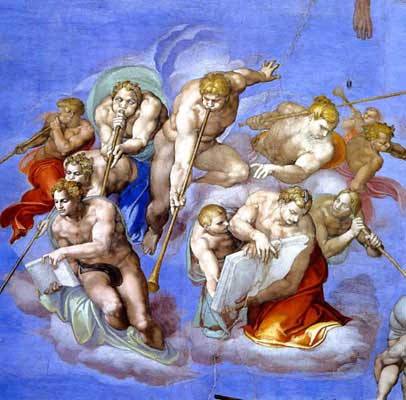
| Detail from Michelangelo's Last Judgment in the Sistine Chapel |
There are many correlations between this Sunday’s Mass, the last one of the time after Pentecost and thus signifying the end of the liturgical year, and next Sunday’s Mass, the first of Advent and the beginning of the year. I highlight only one of these correlations as found within the collects which begin the Masses. The first word of each prayer in Latin is Excita. Of course, the English mind immediately thinks of the word excite, and truly one is correct in coming to this conclusion. Yet what does it mean to excite?
The Lewis and Short Latin Dictionary (an essential reference for those studying the venerable language) offers a few ways to understand this word Excita. It defines Excita the verb as to raise up, to arouse, awaken, incite, or enliven. We see, then, that this word signifies the action of stirring up or even waking up one from some state of inactivity. This begs the question: Why does the Church use this word not only on this day but also for next Sunday’s Mass?
We will look at the use of Excita for next week’s Mass next week (a little incentive to keep you coming!) but for this week, we can link Excita to the image Our Lord presents in the Gospel of the angel’s trumpet. In the midst of describing in a mysterious manner the last days of the universe, Christ tells us that the Son of Man “shall send his angels with a trumpet and a great voice” after He has returned (Mt 24:31). It is this passage that is central to interpreting the Church’s use of this word in our prayer and what effect it should have upon us.
This month of November is normally dedicated to the consideration of the Last Things since the Sunday Masses place us this impending mystery before us. While this theme is certainly appropriate for the end of the liturgical year, it is also the fundamental inspiration for why the Church operates in this world. Eagerly awaiting the coming of her Savior, of her beloved Bridegroom, the Church strives to call souls to that same hope and same love before the angel’s trumpet is heard, before that same Bridegroom comes to carry out His most terrifying task as the Judge of the living and the dead.
But this task of calling does not end once souls have entered into the bosom of Holy Mother Church. Far from it! For now comes the task of leading souls away from sin, from Satan and all his works and pomps, so that these souls may begin to live and breath that same faith, hope, and love with which Christ infused the Church. We must always remember that our entrance into the Church, our incorporation into the Mystical Body of Christ, does not come with a guarantee or a punched ticket; it comes only with a promise: “Abide in me, and I will abide in you” (Jn 15:5).
How often it happens in our lives that we are thrilled with entering into some new activity or receiving some new toy or gadget, yet that thrill vanish after a short time and the activity becomes routine or boring, the toy becomes old and no longer carries the same curiosity. This is most especially true in our ecclesiastical life, and even more so for those of us who have discovered or returned to the Church: we are excited and filled with awe at her teachings and her rites, her Gospel and her history, and we seem to want more, more, more! Yet we sink into a pattern of familiarity, of routineness, a pattern that seems to make all of this just seem like anything else. Our minds become dull with the loss of that newness, our hearts grow weary because what we expected has not come to be, our souls seem to become fixed in their ways or (even worse) to start retreating from the progress we had made back to the old comfortable sins, the easy way of living. Like the natural world all around us, we seem to shrivel up and grow dry and cold.
It is to this that the Church, as a most loving and caring mother, knowing what is best for us, concludes the year. She cries out to us: “Wake up! Rise up! Awake from your slumber!” She shocks us like a foghorn to the ear, like a bolt of lightning surging through our bodies. The Church, in her perennial wisdom, knows that we human creatures too easily slack off and grow weary of the fight, grow tired of waiting, and so she revives us by her prayer. “Stir up your people, we beseech you, O Lord!” she cries in our Collect. Stir up your people, that they may rise from their sleep and remain true to your word.
Let us, then, be roused from our complicity. Let us be awakened from the slumber of sin and the ease of error. Let us arise and be “strengthened with all might according to the power of [God’s] glory, in all patience and longsuffering with joy” as St. Paul encourages us in our Epistle this day (Col 1:11). If we have failed in sin, let us beseech God’s mercy. If we have grown slack in our spiritual lives, let us pray Him that His grace may envelop us and His Holy Spirit stir us up to activity. If we feel weak and unprepared, let us pray along with St. Paul that we “may be filled with the knowledge of his will, in all wisdom and spiritual understanding” so that we may “fruitful in every good work and increasing in the knowledge of God” (Col 1:9-10).
Let us not join the nations who will mourn and bewail the coming of the Just Judge when His sign appears and His angels blast their might trumpets, but let us lead lives worthy of preparing to face the Judge confident in His mercy and His grace as leading us into glory. Let us not fear the trials and tribulations which will come, either the daily struggle which forms us into saints or the heroic struggle which signals that the last and terrible day is at hand. Let us endure all these things so that, being excited by Holy Mother Church, we may be made worthy to be partakers of the saints in the eternal light (cf. Col 1:12).
No comments:
Post a Comment