What do we do with a bad plant in our garden, with a plant that is no longer living? We throw it out and begin again. Even if it is something that we have worked hard on, something that we have put a lot of effort into, we still throw it away when it is no longer viable. It is only the good flowers and the good plants that we keep in our gardens, those which produce wonderful blooms or great fruit. It was the same way with ancient Israel, and it is the same way with the Church today. Only that which is fruitful will remain, while that which is not fruitful is disposed of.
This is the message at the heart of our readings today. God has established his vineyard, and God maintains his vineyard so that it will bear fruit. Our first reading point us toward the first vineyard that God planted, that of ancient Israel. God led the Israelites out of Egypt and planted them in the promised land. He sheltered them, cared for them, provided for their every need. He established them in the land which he had promised to their forefathers. He made a covenant with them, promising that he would be faithful as long as they were faithful.
Yet Israel did fail, and in fact failed often. Time and time again the Israelites would abandon the Lord their God and worship false gods, abandoning the precepts that God had given to them. As a result, God often sent prophets, the servants of the Landowner as we hear in the Gospel, to lead the people back to their God, back to the promise that they had made. But often, even that was not enough.
What then did God do when the people did not return to him? God abandoned them, and left them to their own devices, as they wished it to be. What then was the result of this? The Israelites were often conquered, overtaken by foreigners, and enslaved or even exiled. They suffered miserably as a result of their own folly, of their abandonment of God. Only then did the Israelites return to God; only then did they return, beseeching God for his mercy and to restore them to the relationship they once had with Him.
But finally, there came a time when Israel had to make the ultimate choice. For as we heard in the Gospel parable, there came to them not a servant of the Landowner, but the son - the beloved son of the Landowner, who is in reality the beloved Son of the Heavenly Father. God came among His people, and His people rejected Him. What is the punishment deserving of the people who is finally abandoned their God? The Pharisees and the gospel provide that answer when they respond to Christ saying, "He will put those wretched men to a wretched death
and lease his vineyard to other tenants who will give him the produce at the proper times." And that is what Christ did: he began a new vineyard, the vineyard that is the Church. And this is the Vine onto which we the branches have been grafted through our baptism and through our reception of the sacraments.
Christ has firmly planted his vine so that none may overthrow it. But that does not mean that we cannot go bad. On the contrary, we too may become like the ancient Israelites and even though we participate in the church, and her visible rites and appear to be Christians, we may still imitate our forefathers in abandoning our God, and not worshiping Him and Him alone as our true God, imitating the ancients in producing wild grapes, sour grapes which are inedible and worthless. Admission into the church does not automatically equate into salvation. We are called by God to go out and produce fruit, the fruit of the faithful life, the fruit of a life oriented towards God, oriented towards Christ.
How then do we produce this fruit? We do it first by believing everything that the Church teaches us. Since the Church has been founded by Christ, by God himself, to be the trustworthy authority here on earth, the motherly voice that we can listen to for guidance and instruction, we must hear what she teaches us, no matter how difficult it may be for us to hear it. We must believe what she teaches as being true and right. Just as ancient Israel had the authority of Moses and the prophets, so too do we have the authority of the pope and the bishops.
But belief is useless unless it is put into action. What we believe as Catholics must be put into practice. If the Church teaches that something is sinful, then we must avoid it. If the Church teaches that something is good, then we must promote it and work to implement it in our lives. If we have failed to live up to the Church's teaching, then we admit our errors and seek pardon from God and from His Church. Each of us must live our lives as God knows is best for us, as the Creator who fashioned each one of us from before the dawn of time.
Above all, look to the example of the saints to show you how to be fruitful in your own life. The saints each had their own calling from God and their own challenges in their day, but each remained faithful to God and to His Church in their lifetime. Consider St. Francis of Assisi and his radical poverty and intense love of Christ, or St. Joseph, the humble carpenter who become the foster father of Christ. The greatest example and help we can have is from the Blessed Virgin, the Mother of God and the Queen of All Saints. Seek her intercession and follow her example of fidelity and fruitfulness in your own lives.
Let us take the advice of St. Paul to the Philippians: not to be anxious, but trusting in God who will provide to us true peace of heart, the peace beyond understanding which safeguards us against doubt and fear. Let us "Keep on doing what [we] have learned and received and heard and seen" in Christ, in His Church, and in His saints so that our lives may bear the fruit which we meant to produce. Let us not produce wild grapes but the fruit of holiness, the fruit that lasts unto eternal life.
Sunday, October 5, 2014

Saturday, September 27, 2014
Intentional Discipleship II - Sep 27-28
This is the second of two homilies preached at St. Francis de Sales Parish in Benedict, MD, at the request of the pastor on the topic of intentional discipleship. To see the first homily, click here.
Last week, we looked at the basis for intentional discipleship. We discovered that it is founded upon a person, upon the greatest Person to ever live on this good earth. We saw that our reason for being in this building is founded upon the person of Jesus Christ, the Son of God become man. In this we realized that our religion is not founded merely upon His actions and words, but also in our reaction to those same actions and words, to how our lives are impacted by them. Now that we see what is the reason for being disciples, and furthermore for becoming intentional disciples, let us find out what it takes to do so.
It is Saint Paul who offers us a wonderful picture of what it means to be a disciple of Christ in his letter to the Philippians. In directing the church at Philippi towards holiness, St Paul offers this reflection on what it means to be a member of the Church, to be conformed to Christ. He gives three ways to live the Christian life, to be intentional disciples. The first is unity. We as Christians are called together into the one Body of Christ, into the one flock which is the Holy Catholic Church. If we are one Body, then there must not be division within that Body, just as we cannot tolerate a division within our own bodies. A group of cells that grows corrupt and poisons the human body is called a tumor, and is oftentimes fatal for the body and for the tumor. It is the same within the Body of Christ: when Christians plot against the Lord and His chosen leaders (see Ps 2), they form a tumor within that mystical Body. This is not the way of Christ, this is not the example of the saints.
Saint Paul encourages the Philippians to “complete my joy by being of the same mind, with the same love, united in heart, thinking one thing.” Why does ask this to be done so as to complete his joy? Because it is the joy of every true pastor to see the flock united in one just as God desires it. The Spirit of God does not sow dissension and disunity, but the seed of unity and cooperation. The laity and the clergy are called to cooperate for the good of themselves and the good of the other. The laity are called towards obedience to the Word of God and their pastors, supporting them in their labor in the fruitful fields of humanity, while the clergy are called to preach the full Word and distribute the life-giving sacraments to the laity. There is no room for either of us, laity or clergy, to foment discord out of our own selfish interests or to promote ourselves. We are all meant to be united in Christ, thinking upon the one thing necessary: what it takes to receive our eternal salvation. Let us begin to work to do so.
Continuing in his encouragement, St Paul exhorts the Philippians to “humbly regard others as more important than yourselves, each looking out not for his own interests, but also for those of others.” This is the mark of true charity: a concern that looks towards the needs of others and not merely to ourselves. Why must we be always so focused upon our own needs and wants when there are so many who are in need of much worse? Why do we seem leery of showing that charity towards others in our lives? Did Christ desire only a few to know Him and all that He taught and worked or did He not bring about wondrous works before the eyes of the public?
Charity must begin at home, they always say. And in this they are correct, for charity must begin among ourselves. We are called to support one another, to pray for one another, to reconcile with one another. This charity operates in accord with that unity which we looked at earlier, but the charity which Christ commands and which St Paul describes cannot end with our fellow parishioners. We are called to be concerned for our fellow Christians around the world who are our brethren in the faith. We are called also to love all who are our neighbor as ourselves, desiring the good for them, the ultimate good which is a fruitful relationship with Christ and with God.
In the early centuries of the Church’s life, the pagans marvelled at the way the Christians lived, how much they cared for all around them, not just their fellow Christians. This was the way by which Christianity was spread throughout the world, by our demonstration of what Christ commanded, by our imitation of Christ’s love witnessed upon the Cross. If we do not have love, then we cannot share it. Where is your charity? Where is your love? How much have you cared for the Church, for your parish, for your pastor? How much have you loved God and shown Him that love? Indeed, until we begin to love God, we cannot begin to love our neighbor to the extent to which we have been called.
Concluding his remarks, St Paul offers up the third means to living as intentional disciples: “Have in you the same attitude that is also in Christ Jesus.” What attitude is that? It is humility, as we see from the magnificent description of Christ which follows:
Who, though he was in the form of God,
did not regard equality with God
something to be grasped.
Rather, he emptied himself,
taking the form of a slave,
coming in human likeness;
and found human in appearance,
he humbled himself,
becoming obedient to the point of death,
even death on a cross.
Jesus Christ, being God, being a member of the divine Trinity, did not let that separate Him from His people, from us. In obedience to the Father, He became like one of us, He who is above everything and far greater than everything. He humbled Himself by willing to become like us in everything except sin: becoming a babe in the womb, becoming a child dependent on His parents, becoming a man dependent upon His own work to live. All of this He did even to the point of the cruel death He suffered upon the Cross for the salvation of the world.
That is the example of humility we are to follow. Not accounting ourselves to be anything great and important, but emptying ourselves of vanity and self-deceit so as to be obedient to our heavenly Father. Not desiring the higher places and greater honors, but submitting ourselves to the lowest places and being nothing in the eyes of others so that the honor and the glory go to God. Recognizing that we are indeed nothing next to God, yet knowing that God became one of us so that we might in turn become God-like ourselves; so that, just as Christ was exalted to the right hand of the Father and His name echoes triumphant even in the bowels of Hell, we too may be exalted in the halls of eternal life.
But how will all this come about? How can we achieve this unity? How can we grow in charity, towards God and towards others? How can we become humble and Christ-like? This is where the rubber meets the road for intentional discipleship. It must echo in every facet of our lives. Look into the lives of the saints and see how they lived, and you will see this echoed in every one of them. They never lived the Christian life in halves or quarters or any other sort of division, separating what they believed from how they lived. And it must be the same for us. Our lives must echo with unity, charity, and humility if we are going to receive the reward that God desires for us.
But how? As with all things in the Christian life, we must be a people of prayer, a people in conversation with God, which is the true heart of prayer. How can we do anything if God is not there to help us? How can we succeed without God? We must pray, and in fact we must pray every day for God’s help and for His grace in order to accomplish what He wills for us. It is primarily through prayer that we will succeed. Without drawing nearer to God, most especially in the most central prayer that we have - the Holy Mass, without that we cannot gain our reward.
Yet prayer is useless if it is not tied to action, to works. Just as Christ was obedient in every moment of His earthly life, striving to accomplish the will of the Father, so must each moment of our life be more united to the same divine will. We cannot be saints on Sunday alone, piously praying and participating, and doing nothing else the rest of the week. We cannot do that in any other facet of our lives, so why would it be the same as far as our religious life? If we only cooked for one day, we would starve. If we only showered for one day, we would be filthy and smelly. If we only slept for one day, we would make ourselves crazy. And it is the same in our relationship with God.
Flowing from our prayer must be an ever-increasing desire to obey what God has laid down for us. This will certainly be different for each of us, since we each have a unique vocation from God, but there are certainly a few general principles to live by. First, avoid sin. How can we do that? By knowing what is sinful, and working to remove the occasions of sins and temptation from our lives. Second, do good. We do this in the same way as avoiding sin, by learning what is good and increasing it in our lives. Third, trust in God. Without hope in God’s grace and God’s mercy to help us be intentional disciples, we cannot succeed. He is there for us, just as Christ is near to all who call upon Him. When in doubt, pray and ask for help, for guidance, for relief. Seek and you will find, knock and the door will be opened.
Fourth and finally, trust the Church. Christ has not left us by ourselves to discern all this, but has given us an authority that we can trust to guide us in these matters. This is probably the hardest for us, because we would rather trust ourselves rather than another. But Christ did not trust Himself; He did everything in union with the will of His Father, and we must act in a similar way. Listen to your pastor, your bishop, the Pope: these are the voices by which God speaks to us still. Consult your pastor for guidance or need. Read a catechism and learn what the Church proclaims. Seek the aid of the Church where you can find it.
This is the heart of intentional discipleship - to become what we were meant to be from the beginning: the children of God, the sons and daughters of the heavenly Father, the brethren of Christ the Lord. Let us not lose sight of this goal, but let us fly towards it. Let us begin to be like the reformed son and do our yes even if we have said No before. Let us live not for this world, but for everlasting life. Let us not be held back, but instead race ahead so as to win. Let us reach and grasp for the prize, so that we will not be sorrowful for having lost it. And let us help one another to do the same and be the same, becoming the disciples we should be, so that we will become the saints that God wants us to be.
Saturday, September 20, 2014
Intentional Discipleship I - Sep. 20-21
This homily was given as the first of two homilies for St. Francis de Sales Church in Benedict, MD. The pastor has asked me to give these homilies concerning intentional discipleship.
I have been asked to preach and discuss about intentional discipleship while your pastor is away. That’s not what I am going to do directly. I want all of you for this weekend to focus on one question, on this one question: Why am I here? I do not mean the great philosophical question about our existence and all that. I am asking each of you to consider why you are here, why you are present in this church at this hour. What leads to your decision to come here to worship? Could you not be spending that time in a more useful pursuit rather than sitting here listening to me speak?
I’m sure quite a few of you have thought that at some point in your life, questioning why you need to grace the church with your presence. Perhaps you have seen the results of that inquiry in your family and friends who are not now present here. Perhaps you’ve come close to doing the same. Yet something keeps you coming back, something poking at your heart or some small voice perhaps echoing inside telling you that you need to go, you need to be there. And so you continue to come, you continue to be present, yet you probably feel ...
Is this how we are supposed to be in church? Is this what this hour or our life is meant to be like? Or is there meant to be more? Are we called to be spectators, observing what is happening and not doing much more; or perhaps are we called to something more? The prophet Isaiah declares “Seek the LORD while he may be found, call him while he is near” (55:6), and in this message we can see our response. Our lives are meant to be a pursuit after something: even better, our lives are meant to be a pursuit of some-ONE, an important distinction. We are made for the Lord.
This is why we are meant to be here in this building. This is why we are called to gather together, to gather as one. We are meant to be discovering who this Lord is, and what it is that He desires from us. We have been made for God, as Saint Augustine famously said in his autobiography, and our hearts are restless until we rest in Him. Admit it: how little does this world satisfy? And I mean truly, deeply, completely, without any emptiness, satisfy you? It cannot! It is incapable of doing so! Everything that exists around us is not meant to be the be-all and end-all of our lives. If you were to sit down and consider everything you hold as satisfying and truly consider the meaning of satisfaction, you would see that there is nothing that this world can offer which can satisfy that definition.
Things in general, and specifically money, cannot do it: we are always desirous of more, even when we have enough. Honor or prestige are fleeting and can change from minute to minute: how respected was Ray Rice before the video emerged, or any major figure, be it sports or politics or entertainment. And speaking of all those things, none of them can truly satisfy: every sports game ends, leaving us desiring more action; every political fight either breaks us or makes us addicts, movies and television all have an end, a point when the credits roll and no more is to be seen. None of these things can satisfy us, none of these things is enough. Then where are we to quench this thirst, this desire for something in which our hearts can rest?
Our hearts are meant to rest in a person, in the greatest Person to ever live: Jesus Christ of Nazareth, the God-man. This is the heart of the Christian religion, of the Catholic experience as passed down to us from Christ Himself: to approach this man who is more than He seems; whose wisdom is far beyond anything we have heard; who has power over everything, even death. Our cry should be the cry of the people as recalled in the Gospel of Luke when they behold Jesus raise a young man from the dead: “God has visited His people!” (7:16) Indeed, God has visited His people, and continues to visit them every time the Holy Mass is celebrated.
Our hearts will continue to be restless until we meet Christ, until we encounter Him and engage in the relationship He has desired to have with each one of us from all eternity. This is the fundamental message of the Church: “Come and see!” (John 1:39) Come and see the one who proclaims the Kingdom of God, that reign in which there is no pain, no sorrow, no loss, but there is found peace. Come and see the one who brings about that kingdom by acting in obedience to His heavenly Father, even unto the death of the Cross (cf. Phil 2:5-8), that death which heals the world of sin. Come and see the one who is truly King, victorious over sin and death by rising from the dead. Come and see the King who is still with us, who is still present to us, and who desires to be with you.
But this cannot be done without our action. Christ beckons to each and every one of us, calling to us, drawing near to us, wishing to fill us with His life-giving Spirit. Yet we can turn Him away, either through indifference or through distraction. We can ignore Him and remain as we are now, but it will come at a cost. In the parable of the workers found in the Gospel of Matthew, Christ says that the landowner came to gather men to work at various hours of the day, even at the last hour before dusk. The landowner, upon the completion of the work, gives each worker the same reward. Yet what about those who did not answer the call of the landowner? What happened to them? They were not rewarded, but were left out, without any reward, without any consolation.
This parable strikes at the heart of what I have been trying to tell you. No matter your age, no matter how little you may know Christ, no matter how little you may relate to Him, it is not too late. Jesus beckons to you to come to find the work that is the heart of our relationship with Him. I do not shy away from saying that it will be work: consult the lives of the saints to see how hard it was for each of them to work so as to come to know Jesus better, love Him completely, and serve Him in everything. God does not want to lose you, but you have only this life in which to find Him. After this life, we will either enter into the joys of our reward, even the little that we have done, or we will sink into the oblivion of hatred and despair which plague those souls who chose on their own to abandon God, to ignore Christ, to despise the Holy Spirit. What we do in this life indeed echoes for eternity, and it is completely in our control.
Our religion is not for bystanders or spectators or loungers; our religion, our faith is for soldiers who hear and answer the call, for pilgrims who rise up and wander towards that which should be truly sought, for lovers who discover one in whom their love can find rest. Do not be settled in your faith, because faith does not beget complicity. Saint Paul told the Galatians that “whilst we have time, let us work good to all men” (6:10), and he told the Philippians to “conduct yourselves in a way worthy of the gospel of Christ” (1:27). Let us hear and respond, let us seek for the rest which our hearts have been yearning for, let us find the one who loves us and desires us to love Him before it is too late. Indeed, let us discover the meaning of our faith, the purpose of our worship, and the goal of our religion: to know Christ Jesus and to know God and to live our lives conformed to what they desire for each of us. Let us not wait for heaven, but let us reach for heaven, for only by reaching will we be able to grasp.Saturday, August 30, 2014
Charity - 12th Sunday post Pentecost (EF)
This homily was given at Old St. John Church in Silver Spring, MD.
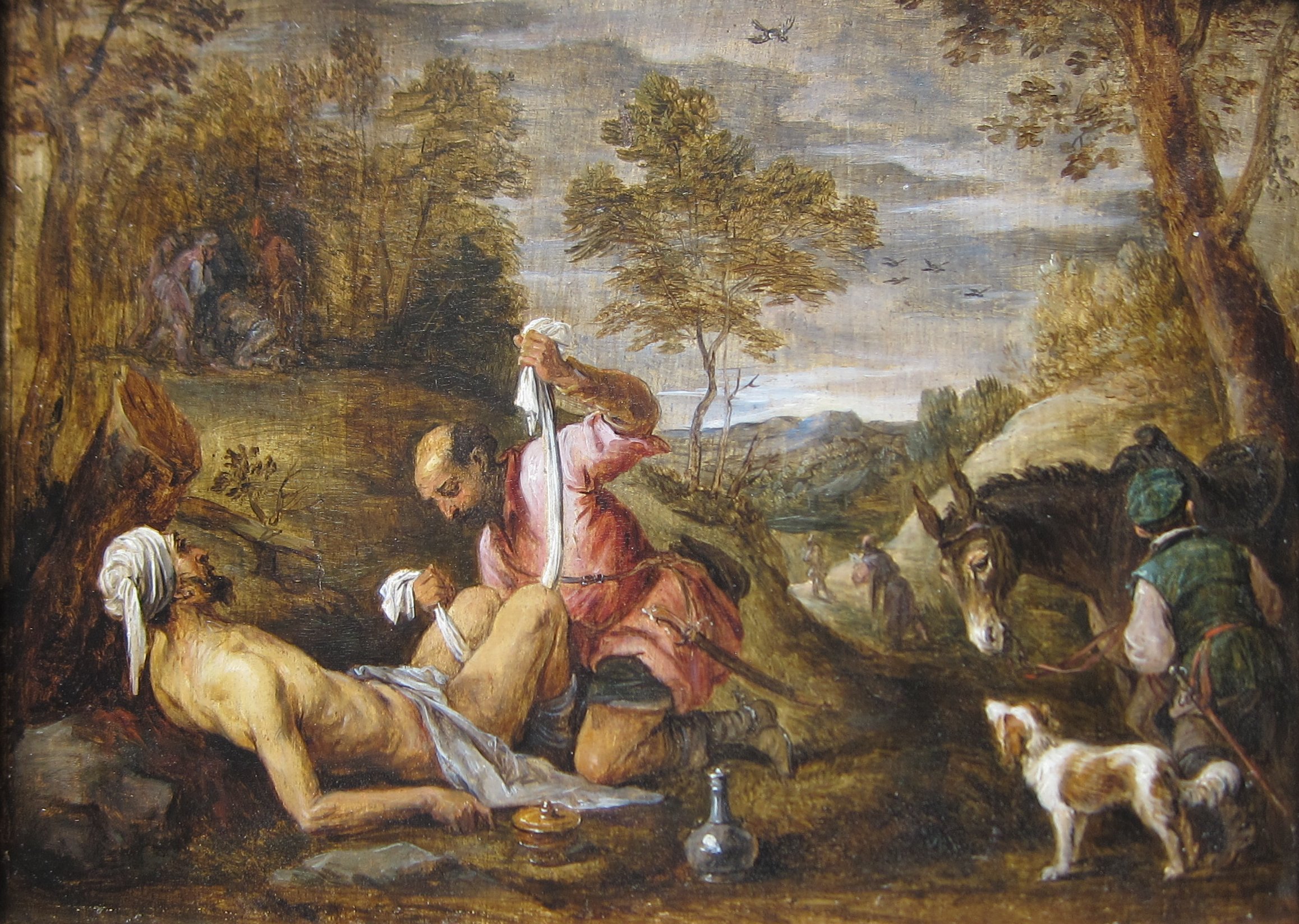 |
| The Good Samaritan |
Charity is one of the many virtues that our Lord preached upon in His life, and the Gospel for our Mass today is, as it were, the pinnacle of that preaching. For in expounding the parable of the Good Samaritan to the lawyer, Christ present not only the ultimate definition of human charity, but also gives witness to the divine charity which stands as the model for human charity. Indeed, this parable is a summary of the history of salvation and the triumph of Christ in restoring man to God. Let us then go out to the deep and plumb the depths of these sacred words.
The parable opens with a certain man descending from Jerusalem to Jericho. The man is seen to represent all of humanity in the parable. Jerusalem, whose name signifies the city of peace, represents the tranquility of Eden at the beginning of creation. The real-life description of the descent from lofty Jerusalem to lowly Jericho represents the descent of man from the garden into the world. But this downfall was not done by man alone, for on the road the man encounters robbers. Who else can these robbers be but the devil and his demons who strove and continue to strive against God in deforming man? The demon robbers stripe man of his original glory and wound him with the wound of concupiscence and leave man half-dead, forced to deal with the reality of death and sin.
Along comes the priest, who stands for the Law imposed upon Israel on Mount Sinai. What does the Law do for man? In the end nothing, for the Law is not meant to be the summation of life. Saint Paul points this out to us in the epistle of our Mass when he says that he has been made the minister of the new testament, the testament written not in letters as was the Law, but infused by the spirit of grace of God. The Apostle shows us that the letter of the Law kills, or more appropriately, does not bring life, while the spirit of grace brings life to man. But Christ desires especially to demonstrate to the lawyer to whom He declares this parable how the Law alone is not capable of bringing life to man. And so the priest passes along.
Along then comes the Levite, representing the prophets who came after the imposition of the Law. These are the ones who pointed out the sins of Israel and her people, calling them back to God through right living and right worship. Yet again, though, the prophets are not the be-all and end-all. The beginning of our Gospel today highlights this when Christ tells His disciples that the prophets themselves desired to see the day of Christ but did not see it in their own time. All of the prophets point towards the coming of the one who will truly bring the promise of God to fulfillment. And so the Levite passes along.
The last one to come to the wounded and half-dead man is the Samaritan. We must first recognize the significance of this title to the Jews of the time of Christ. A Samaritan was one who followed only the teachings of the Pentateuch, the first five books of the Old Testament. They were seen as impostors in the eyes of the Jews, as those not open to the fullness of truth, as perhaps Catholics have labelled Protestants in years past. So we must realize the jarring reality of hearing good things said about a Samaritan before first century Jews, and how this would have really opened the eyes of the people to what our Lord desired to tell them.
It is quite obvious by now that the Good Samaritan represents Christ our Lord and His work whilst dwelling here on earth. Hear what the Samaritan does: He comes near to the wounded man, just as Christ comes near to us by becoming incarnate. He has compassion on the half-dead man, just as God has compassion on his half-dead people. He covers the wounds so that they may heal, just as Christ is covered in the punishment due to humanity so that we may be healed. He pours upon the wounds sweet-smelling oil and reviving wine to aid in healing, just as Christ gives us the oil of absolution and vivification through Holy Communion.
Having done what he can to help the wounded man, the Samaritan places him on his beast and brings him to the inn. Likewise, Christ picks up humanity, wounded in sin, makes us members of His Body so as to carry us, and brings us into the comfort of Holy Mother Church, where humanity can find its rest and relief from the burden of sin and error. The Samaritan entrusts the wounded to the innkeeper, giving him pay and promising more to come when he returns. Christ entrusts souls to His Apostles and their successors and coworkers along with promising them that, when He returns in glory, He shall repay them whatever they have given of themselves.
How magnificent is the charity of God! How wondrous is this great work done by God in preparing the way to reconcile the world to Himself! Indeed, how great should be our thanksgiving to God for this tremendous gift which He has given freely of Himself. All of this God has done to restore us to that glory which we first possessed at our creation and to prepare ourselves for that final and overawing glory which awaits the faithful at the end of the age. This is what Saint Paul marvels at with the conclusion of today’s Epistle. If even the old Law could bring glory, though it did not bring life, how much more will the new and eternal spirit of grace bring glory to man?
Yet we cannot merely marvel at the works of God, we cannot just appreciate what has been done for us. We must follow in that example in our own lives. Why did Christ give us this parable? Because the lawyer had asked a question: Master, what must I do to possess eternal life? The lawyer was confident that merely being a right-minded Jew was enough. But the heavenly Master seeks to open his heart and ours by showing the summation of the Law and how it will be perfected in Christ. It is the same with us. We cannot presume to enter into Heaven because we are Catholics, or even faithful Catholics: we must imitate the divine charity in our lives.
Our lives must exhibit the two great commandments and draw others to desire to know the great Lawgiver and Redeemer who has inspired us to live in such a way. Certainly, we must love God completely because it is right and just to do so. We must seek to honor Him through prayer and worship, we must seek to draw nearer to Him, to plunge into the depths of divine intimacy as have done all the saints before us. But we must also recognize and serve our neighbors as ourselves: as fellow human beings who share the same wounds and need to be healed of those wounds through the mercy and grace of God as found in His Church.
Let us then turn in confidence to God in all our needs so that we may receive His gifts and return them to Him in turn. Let us cry out the words of our Introit: God come to my assistance! Lord, make haste to help me! Let us trust that our Good Samaritan is near to us, carrying us with Him through thick and thin, through all dangers and perils, in the safety of His Church. Let us seek to live our lives driven by these two great commandments of total love of God and of neighbor so as to spread the kingdom of Heaven among us. And let us seek from God through the intercession of the Blessed Virgin Mary the gifts and graces to respond to our own call to imitate the Good Samaritan in bringing healing to this broken world, and the promise of future glory in the never-ending world to come.
Saturday, August 23, 2014
Humility and Healing - 11th Sunday post Pentecost (EF)
Homily for Old Saint John Church, Silver Spring, MD
 |
| Ephphetha |
Can one be healed if one does not wish it? Can the soul that is adamantly obstinate in its deafness and dumbness truly be healed? This is a question that arises from our Mass today, observing the sacred workings of our blessed Lord in demonstrating His divinity through healing the deaf and dumb man. For certainly, that man presented to Christ wanted to be healed, wanted to be freed from this muteness in which he had lived for so many years. Yet what about the soul that does not wished to be freed? What if there is a person who does not wish to receive hearing and speech?
Certainly, we would be flabbergasted that one would not desire these most important senses. We would question one, saying, “Do you not want to hear the sounds of nature rolling about us, the birds and the bees and the trees and the wind? Would you not want to hear the magnificent works of the great composers; Bach, Mozart, Beethoven, and many more? Why would you not want to have a voice with which to cry, to laugh, to shout, to sing, to rejoice?” We cannot comprehend the idea that anyone would not want to communicate with the outside world by hearing and speaking, yet we are witnessing a society that is committing this grave error right now in desiring not to hear and not to speak with God.
We are bystanders and witnesses to the great forgetfulness of modernity. Western society has become deaf and dumb about God and to God. It is a page pulled right out of 1984: Sin is proclaimed to be good and good is proclaimed to be evil in a masterstroke of doublespeak. Christians are constantly declared bigots, Luddites, and hate-mongers whilst the immoral elite are seen as truly open to others, more concerned with the whole person and far more right in understanding the needs of humanity. We have seen this plague of spiritual amnesia grow and spread within our country and perhaps even our families, so that we feel that we are at times the only people remaining with a firm head on our shoulders.
Is there any hope for the world? Is there a possibility of conversion for our society, to save it in time before its self-destruction is completed? Our Lord confirms this possibility for us: “With God, all things are possible.” (Matthew 19:26) Yet how can this be brought about? How can our society be healed of its moral deafness and willful silence concerning God? It is the same solution as when Christianity spread through the Roman Empire and throughout the whole world: there must be souls who bear witness to the centrality of Christ in their lives and souls who proclaim the triumph of Christ over sin and death.
There cannot be a vibrant and healthy Christianity without souls whose very being seems to radiate with the joy of Christ as their King and their Lord. But for this to happen, these souls must be humbled from their proud and erroneous ways. This is the example of Saint Paul in our epistle. The great Apostle to the Gentiles, in writing to the Corinthians, declares that he is the least of the Apostles because he should not be an apostle due to his persecution of the Church. The Corinthians may not know the whole story, but we are privileged to know it in reading the Acts of the Apostles: how Saul stood by, holding the coats of the stoners of Saint Stephen; how Saul, zealous for the God of hosts, rounded up Christians and sent them to the high council to be punished even with death; how he even obtained permission to go out to Damascus to pursue the Church of God there and destroy it. Yet we are privy to the rest of the story: Saul’s conversion on the road to Damascus, his encounter with the risen Christ whom he was persecuting, his healing at the hands of a disciple, and his mission to the Gentiles.
The witness of Saint Paul shows us that, no matter our past or even present circumstances, we too are able to formed into the holy witnesses of Christ our crucified and resurrected King. God is not a respecter of persons, but chooses those whom He wills to be His witnesses and His holy souls. In this we must bow before the majesty of God and humble ourselves that He has chosen us to be with Him here and now, to adore Him in the most Holy Sacrifice, and to be nourished by His Son, by the Lord who has charge over both body and soul. But if we are to be His witnesses, if we are to be His holy souls, His saints, we must seek to be continually healed in our souls, and in this we should reflect upon the Gospel.
How is it that Christ heals the deaf and dumb man? First, He removes the man from the crowd. In this, the sacred commentators see that we must remove ourselves from the noise and the crowds of this world which drown out the voice of Christ speaking through His Church. How can we hear Christ if our ears are not attuned to His voice? Next, the Lord places His fingers in the ears of the man and spits upon the man’s tongue. The commentators see in this the gifts of the Holy Spirit enlightening the soul so as to begin to hear and proclaim the Word. Our Lord then groans in prayer to His Father, and utters a word still used in our liturgy today: Ephphetha, be opened. At every baptism, the priest prays this divine command upon the recipient, beseeching God to open their ears and mouth so as to hear the Word of God and to proclaim it always upon their lips.
So it must be the same with us. We must be separated from sin and all wickedness so as to hear Christ speak to us, to be more open to the promptings of the Holy Spirit. We must receive and bring to fruition the gifts of the Spirit so that our lives may reflect the triumph of Christ our King. And we must be opened by the grace of God to be what we are meant to be: sinners mindful of our past, as was Saint Paul, yet hopeful that God’s grace will not be voided in us by our deafness or silence. Our ears and our mouths must not be closed to God by sin but must be opened to proclaim His praise continually upon our lips.
Let us pray that we may be humbled as was Saint Paul so as to be true witnesses to the glory and the reign of Christ. Let us be healed by the divine Physician so that our ears may hear and our lips may proclaim the Word. Let us go forward and proclaim in all things our thanks to God for the victory won for us through Christ. Let us serve God in His Church through obedience and humility, desiring to increase the kingdom through the conversion of souls and of society. May our ears be opened and our lips be separated by Christ so as to hear Him, to praise Him, and to glorify Him in everything.
Sunday, August 10, 2014
Audacity - 19th Sunday per annum (OF)
There echoes throughout all the elements of our Mass today a theme of audacity or boldness. Consider the collect which we prayed at the beginning to prepare ourselves for this particular day: Almighty ever-living God, whom ... we dare to call our Father. Another example which we hear quite regularly comes from the introduction to the Our Father: At the Savior’s command, and formed by divine teaching, we dare to say. The readings for this Sunday also echo with the examples of holy and unholy audacity as a regular part of our spiritual life. Let us dare to open the Scriptures and see where Christ is leading us.
In the Gospel story of the Lord walking on water, one sees an example of audacity in the actions of Saint Peter. The disciples, upon seeing Christ walking towards them on the water, believe it is a ghost or a vision. But our Lord calms their fear and assures them that it is really Him. When Saint Peter beholds all this, he makes a very bold request. He cries out to Christ: “Lord, if it is you, command me to come to you on the water.” Why does Peter dare to ask for this? We must remember that it was Peter who was privileged with the divine insight into who Christ really is: God the Son become incarnate. Perhaps he is desiring to be certain that it is truly his divine Master who stands amidst the thrashing waves.
Notice also what specifically Peter requests. The great ancient commentators see in this question the audacity which emerges from true humility. Peter is always next to Christ, ever serving Him, ever listening to Him. Peter asks to be with Christ as he is wont to do on land so as to be at his natural position. We should take from this how often we should boldly ask God to be with us in our endeavors. If we can truly claim to call God our Father, then why would we ever be afraid to ask Him for our needs? Do we feel that our needs are inadequate in talking with God? Do we feel that we have no right to ask for anything because we are already blessed? Or do we feel embarrassed petitioning God in prayer?
Brothers and sisters, we should never feel inadequate or embarrassed before God. We should certainly feel humble, realizing our weakness in comparison to the almighty God, realizing our littleness compared to the ever-living God, but that should only makes us more audacious in making our needs and desires known to God. God wants to help us be what He has created us to be: the adopted children of the heavenly Father, the new heirs to the magnificent inheritance promised from the very beginning of time. Christ elsewhere encourages us to be bold in asking God for our needs when He tells us: “Ask and you shall receive; seek and you shall find; knock and the door will be opened.” (Mt 7:7) No matter the time, no matter the situation, no matter the feeling, we should never be afraid to pray and ask God for all that we need, both natural and supernatural gifts, so as to nearer to Christ and nearer to God.
Yet there is also a caution within this Gospel story about the limits of audacity. Note that Peter, emboldened by the command of Christ, gets out of the boat and walks towards Christ for a while. The great tossing of waves does not frighten him, but when he sees the strength of the wind, Peter begins to sink. How often do we seem daring to do great things or believing ourselves capable of doing great things yet do we seem far less daring to take up the task of doing the little duties. Holy audacity must not exist only for the great events of our life, but for every little moment also. That is what the saints practiced: not being holy in one moment, but exhibiting in every moment possible the boldness to live their lives completely focused on Christ or on removing as much as possible whatever distracts them from Christ. It is the same with us.
Most of us are not called to be great and famous nor are we called to do great things, but all of us are called to sanctify our lives by entrusting ourselves to the grace of Christ, the help of Christ, and by living Christ-centered lives which echo in all of our actions. Peter exhibits this trait when he cries out to Christ to save him. Even in his moment of weakness, Peter is emboldened to appeal to Christ to help him. And Christ does so, certainly rebuking Peter for his lack of firm faith, but also showing us that we cannot rely on ourselves alone to succeed. It is Christ who dares us to be holy, and it is in Christ that we must continue to find that holy audacity.
The Church herself also offers us a witness of this audacity throughout history. Founded by Christ, maintained by Christ, she continually marches out into the world and proclaims for all the truths of salvation. Undeterred by threats or compulsion, the Church continues the mission that Christ gave her: to go out and make disciples of all the nations. The continual presence of the Church shows us what it means to be audacious without becoming arrogant.
In fact, there is a special class of saints who are held up for us as the ultimate examples of audacity: the martyrs past and present. All the martyrs were given a choice: reject Christ, reject all His teachings and His authority, or face torture, imprisonment, exile, even death. The martyrs, hanging on to the truth, remained bold in proclaiming that they would rather die than reject their Savior. That is why the Church holds them up as some of the greatest saints of history. That is why, whenever we pray the Roman Canon, we hear the Church enumerate so many holy martyrs, including the Apostles and the virgin martyrs who died for love of Christ.
And even today, we should be strengthened by the example of the Christians suffering in Iraq and the Middle East. The Muslim oppressors even today threaten these Christians to either convert to Islam or pay the consequences. Many of these people are fleeing their homes and even dying in the streets because they refuse to reject Christ, they refuse to reject their identity as a Christian, they refuse to reject their salvation. Certainly, we must pray for them and seek to help them as best as we can, but we should also be inspired by their witness so as to be courageous in the face of all the challenges that await us here at home. And make no mistake, we are being challenged similarly to the Christians half a world away with the world trying to force us to admit evil is good and to reject Christ as the only Savior of the world.
Let us then pray that we may have the boldness to live Christ-centered lives, lives which radiate the holy audacity of the saints in entrusting their every need to God and His loving kindness. Let us dare to cry out to our heavenly Father to show us His mercy and to grant us our salvation. Let us be like Saint Peter and cry out to Christ to command us to follow after Him no matter the cost and to strength us to do so. Let us pray most fervently for all this, so that we may dare to merit, through God’s mercy and grace, the heavenly inheritance which awaits those bold enough to ask for it.
Saturday, August 9, 2014
The Light and the Darkness - Transfiguration (EF)
This is my homily for the Feast of the Transfiguration celebrated this past Wednesday in the Extraordinary Form.
In reflecting upon the events of the feast we celebrate this evening, some biblical commentators have called this the temporary cessation of a miracle. For, as they argue, if Christ is God, should not His divine glory radiate through His sacred humanity at every point of His life on earth? Yet the Gospels do not relate to us the viewing of this glory except upon Mount Thabor before the most trusted of the Apostles. Why is it that Christ seems to hide Himself from the crowds and refrains from shining before man?
We must remember first that the heart of humanity remains dark from the consequences of the Fall. The Most High God, up to this moment in history, had been working with countless people in bringing about the beginning of these last days in the life of Christ. Beginning with Abraham, God had formed a people to be his firstborn upon the earth, the tribe from which the Savior would be born. By calling Moses to lead the Israelites out of slavery in Egypt and to the freedom of the Promised Land, God is highlighting the moral order necessary to live as one called to this peculiar relationship with Himself. And by the voice of Elijah and the prophets, God calls these people to know Him completely, to love Him sincerely, and to serve Him without fail.
Yet darkness still reigns within the human heart, corrupted by the action of Adam and Eve. Abraham knew of the smiting of Sodom and Gomorrah by God for their heinous sins of lust. Moses was forced to intercede for the Israelites after they fashioned a golden calf for veneration, even as they beheld the hidden splendor of God dwelling on the top of Mount Sinai. And Elijah witnessed the persecution of Jezebel and Ahaz as they tried to drive the voice of God away from His people. Christ Himself in His earthly life saw the influence of Satan personally and through the progression of the Pharisees’ animosity against Him.
Indeed, it is the contrast of light and darkness which is most striking in this feast of the Transfiguration. From of old, the Church has professed God to be “light, and in Him there is no darkness.” There is nothing hidden or stained within God’s being. His perfection, His infinitude, His simplicity are all so brilliant that they radiate with purity and clarity. Indeed, every time we profess the Nicene Creed, as we shall do tonight, we declare Jesus Christ to be God in quite a few formulae, one of which is declaring that He is “light from light.” When we conclude this Mass, and every celebration of the usus antiquior, we shall pray the beginning of the Gospel of St. John, one of the three earthly witnesses to the Transfiguration, who declared Christ the divine Word to be the bearer of divine light into the world, shining the torch of Truth and Life into the darkness of Falsehood and Death.
But the darkness still remains, the darkness cast upon the world through the work of Satan and the demons, desiring to corrupt all so that nothing of God will remain. In fact, Satan works to bring about his own light as a means of fooling humanity into abandoning God and following the devils into the pits of hell. It is not the light which so shines as to be impossible to behold, but it is the type of light which a fly pursues before it is burned. And perhaps not so coincidentally, this day marks an anniversary of one of the greatest flashes of this false light seen in this world. Almost 70 years ago today, the atomic bomb was dropped and detonated in war for the first time.
How striking is this juxtaposition of light between the Transfiguration and the bomb. One is the light of divinity shining forth in union with humanity; the other is humanity striving to become as powerful as God. One shows the unity of history as the past work of the Old Testament is brought to fruition in preparation for the inauguration of the New and Eternal Testament; the other is a sharp divide between the morality of the past and the carelessness and recklessness of the current age. One draws the soul in awe and some terror towards the realization that there is a being greater than all of humanity who contains all power and glory within His very being; the other arouses terror and a little awe at the sheer power that one man can have at his fingertips over nearly the entire human race. The one is centered upon the man who declared “I have not come to destroy souls but to save”; the other occasioned the quote “Now I am become Death, the destroyer of worlds.”
To which light will humanity turn: the true Light radiating from the King of the Universe, the King reigning from the Cross; or the false light which dazzles for a while but in the end kills all it touches? Dear brothers and sisters, we must pray that we at least will choose to follow after the Light of Christ, that we will desire to pursue that Morning Star which never sets, that we will strive after the Light no matter how dark the times may be. We must listen to Him so as to be continually converted from the temptations of the darkness and that we may imitate the saints in radiating the light of Christ in our own lives. We must discover all which inhibits the light from shining through our works so that we may truly be the light-bearers that we promised to be at our baptism, when we received the light of the risen and triumphant Christ and were called upon to keep that light burning for His return.
 Let us then adore Christ in His majesty and glory, God truly incarnate and become one of us. Let us make a tabernacle for Him in our hearts that He may find rest within us and be our light in times of darkness. Let us receive Him worthily and fruitfully in the hidden glory of the Eucharist, so that His light may become our own light. And let us never fail to seek His pardon for those times when we have succumbed to the darkness by receiving the illuminating wonder of His mercy at the absolution of the priest. Finally, may we take up as our cry these words of Blessed John Henry Newman:
Lead, Kindly Light, amid the encircling gloom
Lead Thou me on!
The night is dark, and I am far from home -
Lead Thou me on!
Keep Thou my feet; I do not ask to see
The distant scene - one step enough for me.
May we be lead by that kindly Light to the glories of eternal life, where we shall share in the joys of that light for endless ages to come.
Subscribe to:
Posts (Atom)